
Cluj-Napoca sits at the heart of Transylvania, and it’s a city I keep sending people to who assume Romania means castles and not much else. The Old Town has its share of that – baroque facades, cobbled streets, a fortress with real history behind it – but Cluj is also Romania’s biggest student city and one of its main tech hubs, so it doesn’t feel frozen the way some historic centers do. Coffee shops, galleries and an active nightlife sit right next to buildings that have been standing since the 1700s, and neither side of the city apologizes for the other.

Cluj’s cultural life runs on festivals, museums and a proper art scene, all of it layered onto a city with Roman, Hungarian, Saxon and Habsburg history stacked underneath. It’s also home to Untold Festival, one of Europe’s larger electronic music festivals, held here every August – worth knowing about whether you want to plan around it or specifically avoid it, since it fills the city’s hotels for the week.
The student population – Babeș-Bolyai University alone has tens of thousands enrolled – keeps the bar scene busy year-round, not just during festival season, and streets like Piezișă, just off the old town, are packed with small bars that fill up most nights of the week rather than only on weekends.
Transportation and how to get there
Cluj has its own international airport, with low-cost carriers running direct flights to a good number of European cities, which makes it an easy add-on if you’re not starting your trip in Bucharest. If you are coming from Bucharest, flying is the fastest option – the drive is a different story.
If you’re driving from Bucharest, the A1 highway covers most of the route, but it isn’t a single continuous motorway yet. A stretch through the Carpathians between Pitești and Sibiu is still being completed in sections, some only opened in the past year or two, so part of the drive still runs on a regular mountain road rather than a full motorway.
Depending on which sections are open when you travel, expect somewhere between six and eight hours rather than a flat seven – and stay alert on the non-motorway stretches, since Romanian mountain roads see plenty of aggressive overtaking. The train from Bucharest is a scenic alternative if you’re not in a rush, though it takes noticeably longer than driving.
Once you’re actually in Cluj, the city’s bus and tram network covers most of what you’ll need. A single ticket runs around 2.50 lei (roughly 60 cents), and you can buy them by SMS, through the transit app, by card directly in the bus, or from kiosks near the bigger stops. The city center itself is compact enough that you’ll likely walk more than you ride, but the trams are worth knowing about for reaching Cetățuia Park or the train station without a taxi.
Bolt and Uber both operate in Cluj and are cheap enough that they’re worth using over renting a car if you’re only in the city itself – parking in the old town is limited and mostly paid, so a car only really earns its keep once you’re heading out to Turda.
Landmarks in Cluj-Napoca
Museums, architectural wonders and local authentic experiences

Unirii Square
Unirii Square is the natural starting point for a walk through Cluj, and most of what follows in this section sits within a few minutes of it on foot. It’s one of the oldest squares in the region, ringed by Renaissance, baroque and eclectic-style palaces, and it still functions as the city’s actual gathering point rather than a preserved-for-tourists showpiece – locals meet here, sit on the steps, and treat it as a normal part of the day.

Banffy Palace
The Bánffy Palace, today the Cluj-Napoca Art Museum, anchors one side of the square along with the former Continental hotel, still known locally as “Conti.” The palace was built between 1774 and 1786 for Count Gheorghe Bánffy by architect Johann Blaumann, and it became a reference point for Transylvanian Baroque architecture more broadly. Emperor Francis I and composer Franz Liszt both stayed here at different points, and the facade still carries the Bánffy family coat of arms beneath mythological statues by sculptor Anton Schuchbauer.
The Bánffy name shows up again outside the city, at the family’s other estate in Bonțida – that castle now hosts Electric Castle, another major festival, which tells you something about how Transylvania’s aristocratic history and its current music scene keep bumping into each other. Inside the museum today, the collections and the interiors are worth the visit on their own merits.

St. Michael’s Church
At the center of the square stands St. Michael’s Church, a Gothic landmark surrounded by the Matei Corvin statuary group – a tribute to King Matthias Corvinus, one of Hungary’s most significant rulers, born in Cluj.
The statues reward a slow look rather than a quick photo: each figure in the group ties back to a specific episode of the Hungarian Renaissance, so it functions less like decoration and more like an open-air history lesson standing right next to the church. Between the Gothic architecture and the statuary, this corner of the square packs in more layered history than almost anywhere else in the city center.

Steampunk & Fantasy Museum
The Steampunk & Fantasy Museum is the odd one out on this list, and deliberately so. It mixes 19th-century aesthetics with science-fiction imagination, packed with interactive mechanical artifacts rather than glass cases you’re not allowed to touch. It won’t be for everyone, but it’s a solid rainy-day option, and it tends to hold kids’ attention longer than most of the historical sites on this list.

Matia Corvinus House
Matia Corvinus House, a 15th-century building near St. Michael’s Church, is traditionally cited as the birthplace of Matthias Corvinus himself, though like most claims this old, take the “birthplace” label as tradition rather than settled fact. What’s easier to verify is the building’s own layered history: Renaissance-era denticled platbands sit alongside older Gothic details, an 18th-century stint as a hospital added baroque changes to the courtyard, and a late-19th-century renovation brought in Art Nouveau touches that were later adjusted again in the 1950s.
Few buildings in the city let you read that many centuries of renovation in one facade, which is reason enough to stop even if the medieval-life exhibits inside aren’t your main interest.

Bârlog Brewery
Berăria Artizanală Bârlog is worth a stop for the building as much as the beer. It occupies a 15th-century structure inside the old Ursus Beer Factory complex, which has been brewing on this site since 1878, and the space was converted into Pub Bârlog in 2019. The beer itself is solid craft brewing rather than a gimmick built around the history – it’s a legitimate stop for a proper pint, not just a photo of old brick.
A short walk from Unirii Square, in the opposite direction from St. Michael’s Church, the Dormition of the Theotokos Cathedral (locally, the Orthodox Cathedral) anchors Avram Iancu Square with a very different architectural mood – Neo-Byzantine domes and a scale meant to assert an Orthodox presence in a city whose historic center was built mostly by Catholic and Protestant hands.
It was completed in the interwar period, after Transylvania joined Romania, and it’s worth the walk over even if you’ve already seen your fill of churches for the day – the interior frescoes and the sheer height of the central dome are unlike anything in the old town.
Parks and places to relax in nature (in Cluj or nearby)
Cetățuia Park
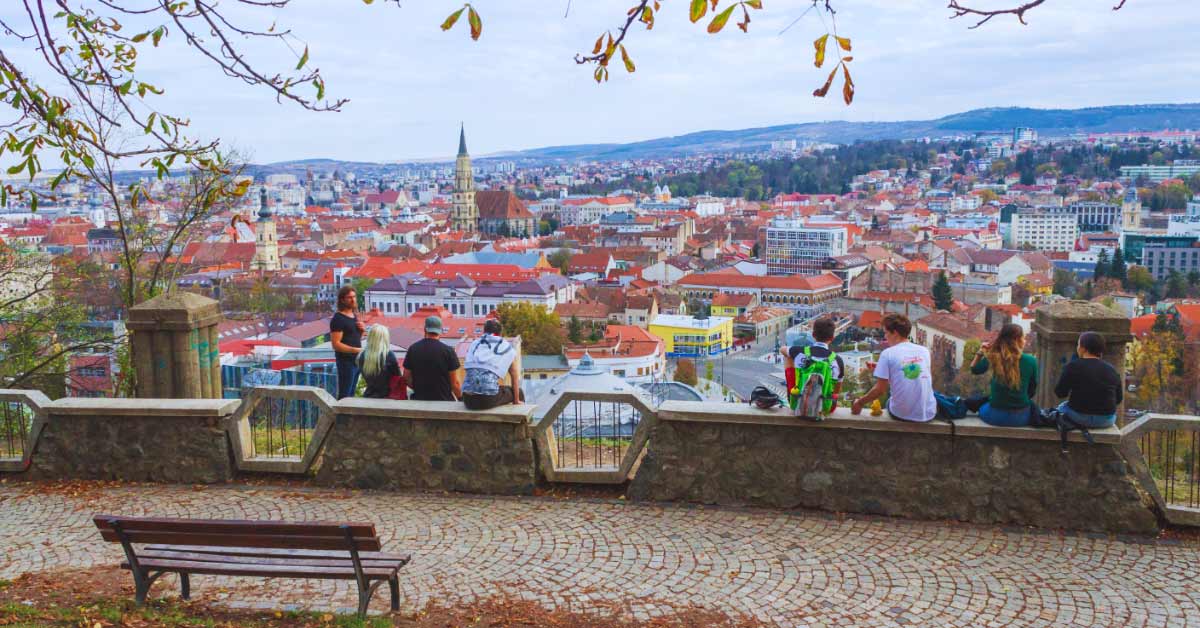
Cetățuia Park sits on a hill overlooking the city and is arguably the best view in Cluj – locals call it the most photographed spot in town for good reason. The 18th-century Cluj-Napoca Fortress anchors the park, and the walk up from the center takes maybe fifteen to twenty minutes depending on your pace, mostly stairs. Go for sunset if your schedule allows it – the light over the rooftops and the Someș valley is worth timing the climb around.
Central Park
Central Park is Cluj’s main green space downtown, built around a lake with paddle boats, tree-lined paths, playgrounds and a handful of cafés along the water. It’s the kind of park that works for an early morning run, a lazy afternoon, or killing an hour before dinner without needing a plan.
The Botanical Garden
The Cluj-Napoca Botanical Garden dates back to 1872 and spans 14 hectares, organized into thematic sections including a Japanese Garden and a Rose Garden, along with historic glasshouses that are worth the visit on their own. It also functions as an active research and teaching garden for Babeș-Bolyai University, so what you’re walking through is a working collection, not just a landscaped park. It sits close enough to the center that it’s easy to fold into a half-day with Central Park.

Turda Gorge
Turda Gorge sits about half an hour outside Cluj and makes a solid half-day or full-day escape if you want actual hiking rather than a city park. The trails range from easy walks to more demanding scrambles, and while comfortable shoes and weather-appropriate clothing matter, most of the main routes are manageable for casual hikers rather than requiring technical experience. If your legs and schedule allow it, pairing Turda Gorge with the Salt Mine in the same day works well, since they’re only a short drive apart.
Turda Salt Mines
The Turda Salt Mines are one of the more unusual attractions in Romania, and the underground scale of the place is what sells it – a massive lake, carved salt chambers, and cavern ceilings that make the whole thing feel more like a set than a mine. Here’s what’s actually down there:

Here are some notable features:
Salt Chambers – vast rooms carved directly out of salt, with formations that create a strange, almost theatrical underground landscape.
Underground Lake – a large lake where visitors can take boat rides, with the cavern’s reflection on the still water doing most of the visual work.
Amusement Park – yes, an actual amusement park underground, with a Ferris wheel and mini-golf among the attractions.
St. Varvara’s Chapel – a small chapel carved entirely from salt, tucked inside the mine.
Echo Chambers – sections of the mine with acoustics strange enough to notice immediately.
Mining Museum – a smaller on-site museum covering the history of salt mining in the region, with period equipment on display.
It’s included in Balkan Trails’ Best of Romania tour as one of the highlights, and it’s an easy add-on to other itineraries if it’s not already built in. Worth knowing before you go: it’s popular enough that summer weekends can mean real queues at the entrance – if you have flexibility, a weekday visit is noticeably calmer.
Where to eat in Cluj – Napoca

Toulouse is the easiest recommendation for a group with different tastes, since the menu spans continents in a way that actually works – English breakfast, African shakshuka, Mexican fajitas, French croque madame, an Arabian combo plate, Italian linguine and a Greek salad all sit on the same menu without feeling like a gimmick. It’s a solid choice specifically when you’re traveling with people who can’t agree on a cuisine, and it works equally well for a long breakfast before a day of walking or a proper dinner after one.

Samsara Restaurant is the better call if you’re vegetarian, vegan, or just want a genuinely good plant-based meal rather than an afterthought salad. The interior is small and cozy, and the covered terrace with its mural is a good pick for warmer months. It’s part of the wider Romanian dining scene worth exploring beyond Cluj too, if the food here gets you curious about what else the country does well.
Where to stay in Cluj
Cluj Apartments – in the center of the city

If you want to walk to everything on this list without thinking twice, this boutique option puts you right in the center, with private apartments rather than standard hotel rooms – private bathroom, wifi, and enough space to actually unpack for a few nights.
Meander Home – outside of the city

If you’d rather trade a short drive for quiet and greenery, Meander Home sits outside the city center in real rural surroundings, while still being close enough to get into Cluj without much hassle. It’s the pick for anyone who wants their evenings quiet after a day of sightseeing.
Hotel Cristal – near the center of the city

Cristal sits in the middle ground between the other two: a modern boutique hotel in a quieter pocket of the city, close enough to Cluj Arena, Central Park and Cetățuia Park to walk to most of it, without being right in the noisiest part of downtown.
If you’re trying to pick between the three: Cluj Apartments if you want zero commute and don’t mind city noise, Meander Home if quiet matters more than convenience, and Cristal if you want a genuine middle ground between the two.
Planning your time in Cluj
Two full days covers the city center comfortably – Unirii Square and the landmarks around it, plus the parks, realistically fill a day and a half, with the second half of day two better spent on Turda Gorge or the Salt Mine as a half-day trip out of the city. If you want both Turda stops properly rather than rushing one, budget a third day.
A rough split that works well: day one for Unirii Square, the Bánffy Palace, St. Michael’s Church and the Orthodox Cathedral, with dinner at Toulouse or Samsara; day two for Cetățuia Park in the morning, the Botanical Garden or Central Park in the afternoon, and the Steampunk Museum if the weather turns; day three, if you have it, for Turda Gorge and the Salt Mine together.
For a broader sense of what a Romania trip costs beyond just Cluj, our Romania and Bulgaria travel budget guide is a useful reference point. If hiking around Turda Gorge has you curious about other natural areas in the country beyond just this one range, it’s worth knowing Romania has several more worth the detour. Our guide to Romania’s national parks covers the rest of them.
Balkan Trails can show you Cluj-Napoca
Cluj rewards people who give it more than a quick stopover between Bucharest and the rest of Transylvania – it’s got the historical layers, the architecture, and enough going on in its parks and nightlife that it stands on its own rather than functioning as a checkbox on a bigger itinerary. Pair it with a day trip to Turda and you’ve got a well-rounded few days: medieval and Habsburg history in the morning, an underground salt lake in the afternoon, and a proper bar scene once the sun goes down.
If you’d rather not plan the logistics yourself, that’s exactly what we do at Balkan Trails – we build routes around what you actually want to see, Cluj included, rather than a generic loop through the same five landmarks everyone else covers. Your Romania tour starts here.