

I’ve said this to every traveler who asks me where to go in Romania if they only have time for one city: skip Bucharest and go to Sibiu or Brașov. That’s a bold claim, and I’ll defend it. Bucharest is worth knowing – but Sibiu is worth feeling. There’s a specific quality to walking through its three squares in the late afternoon, when the light hits those amber and ochre facades and the Council Tower casts its shadow across Piața Mare, that I haven’t found anywhere else in the country.
Sibiu sits in southern Transylvania, roughly midway between Brașov and Sebeș, at the foot of the Cindrel Mountains. It was founded by Saxon settlers in the 12th century – referred to in medieval documents as Hermannstadt – and the German influence is visible everywhere: in the fortification walls, in the rooflines, in the cathedral, and in the general sense of civic order that the old town still projects today. The Saxons are mostly gone now (the community largely emigrated after 1990), but they left behind a city that feels architecturally coherent in a way few Romanian cities do.
One thing you notice quickly if you’re paying attention: the attic windows on the older houses are shaped like eyelids, slightly tilted, giving every façade the impression of looking back at you. Locals call them ochii Sibiului – the eyes of Sibiu. It’s a genuine architectural feature, not a tourist story invented after the fact, and once you see it you can’t stop noticing them on every street.
How to get to Sibiu
By train: CFR Călători runs direct intercity connections from Bucharest (București Nord) to Sibiu – the journey takes around 4 hours on the faster IC trains. Check schedules and book tickets at cfrcalatori.ro before traveling, as the IC trains sell out on weekends. From Cluj-Napoca, the direct train takes approximately 2.5 hours. Prices in May 2025 ranged from 60-100 RON for a second-class intercity ticket depending on departure time – verify current fares before booking.
By car from Cluj-Napoca: Take DN1 south through Turda and then the E81/A1 direction Sebeș, turning onto DN1 toward Sibiu. The drive is around 2 hours in normal traffic, and the approach through the Secașe hills with the Cindrel massif visible to the south is genuinely good. Avoid this route on Friday afternoons in summer – truck traffic on DN1 through the Mureș valley backs up badly.
By car from Bucharest: The A1 motorway takes you most of the way – around 280km, roughly 3.5 hours if you’re not stopping. The last stretch from Sebeș on DN1 is well maintained. This is a more straightforward drive than Cluj, and it’s what I’d recommend for first-timers coming from the capital.
By bus: Several private operators run coaches from Bucharest to Sibiu and the journey takes roughly 4.5 hours. From Bucharest, departures are typically from Filaret or Militari bus stations – confirm the pickup point when you book, as this changes. The bus is often cheaper than the train but less comfortable on longer journeys.

The Council Tower, Sibiu
What to see in Sibiu’s old town
The three squares
The old city is organized around three connected squares that flow into each other – Piața Mare, Piața Mică, and Piața Huet. You can walk all three in 20 minutes, but you’ll want to spend an afternoon.
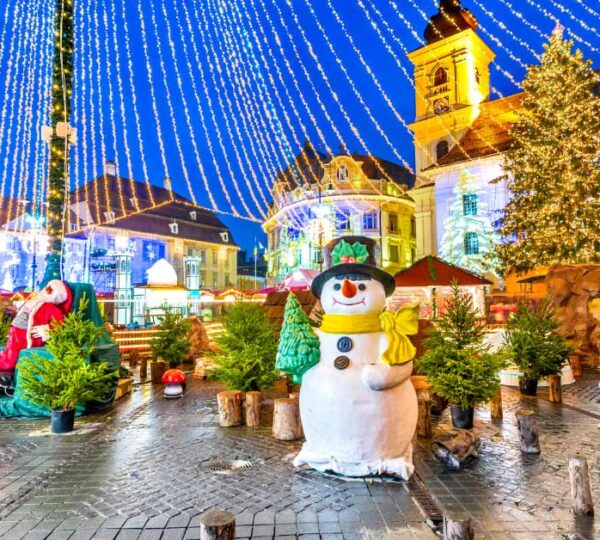
Piața Mare is the main square and the obvious starting point. The Brukenthal Palace dominates the northern side, with the City Hall and a cluster of 16th-17th century guild houses completing the perimeter. It’s lively without being overwhelming, and the cafes along the eastern edge are good for an espresso lung while you get your bearings. The square hosts Sibiu’s Christmas Market in late November through December – one of the best in the country, considerably more authentic in feel than Bucharest’s.

Piata Mare, Sibiu
Piața Mică is immediately below, connected by a passageway under the Council Tower. It’s smaller, quieter, and in my view more interesting architecturally – the scale is more human, the houses lean toward each other slightly, and there’s a good chance you’ll find a local musician there on a Friday evening. This is where the Bridge of Lies sits.
Piața Huet opens up behind the Evangelical Cathedral – a wide, slightly sunken square that feels almost monastic in its quietness compared to the main square two minutes away. The cathedral tower is open to visitors and worth the climb for the view over the Cindrel foothills.
The Council Tower (Turnul Sfatului)
The Council Tower dates to the 14th century and was originally part of the second ring of city fortifications. At seven stories, it’s not especially tall by tower standards, but the staircase is genuinely narrow and the views from the top – across Piața Mare to the terracotta rooftops and the mountains beyond – are the best in the city.
Opening hours: daily 10:00 AM to 8:00 PM (verify before visiting as seasonal hours apply). Entrance fee: approximately 10 RON. The art exhibitions on the intermediate floors are minor; go for the view.
The Brukenthal National Museum
This is one of the oldest and most significant museums in Romania, and it’s genuinely undervisited relative to its quality. The Brukenthal Palace itself – built in 1785 for Baron Samuel von Brukenthal, Habsburg governor of Transylvania – is an 18th-century baroque building that would hold its own in Vienna. The art collection inside includes around 1,000 paintings, with a strong European collection from the 15th to 18th centuries.
The Brukenthal complex spans six buildings across the city. The main palace on Piața Mare is the obvious starting point, but the Natural History Museum on Str. Cetățuii and the History Museum on Str. Mitropoliei are also worth time if you have a full day.
Current ticket prices and opening hours at brukenthalmuseum.ro – I’d recommend checking before going as hours differ by building and season.
The Bridge of Lies (Podul Minciunilor)
Built in 1859, this cast-iron bridge over the small street connecting Piața Mică to Piața Huet is the first cast-iron bridge in Romania still in its original location. The legend is that it creaks when someone lies on it – which is why it became a spot for confessions and declarations, and which probably explains the continuous light groaning that old cast iron makes. In reality, the groaning is thermal expansion – the bridge responds noticeably to temperature changes, which is impressive in itself. Worth crossing, worth photographing from below, not worth building your entire itinerary around.

The Bridge of Lies, Sibiu
The Astra open-air museum
If you have a second day in Sibiu – and I’d argue you should – the Astra Museum deserves two to three hours. It’s located in Dumbrava Sibiului, a forest area about 4km southwest of the city center (take bus no. 13 from Piața Unirii, or a taxi for around 20-25 RON).
The open-air section is the main draw: around 300 traditional houses, churches, watermills, and workshops brought from across Romania and reassembled in a working village format spread over 96 hectares. What makes Astra different from similar museums elsewhere in Romania is the density and the quality of the reconstruction – you can go inside most of the buildings, and many contain original furniture, tools, and textiles. I’ve visited several times and it still takes me by surprise: you round a corner and there’s a fully intact 18th-century oil press from Oltenia, or a Maramureș wooden gate you’d expect to find in Ieud, not in a park outside Sibiu.
Entrance fee: approximately 35 RON for adults. The museum is open Tuesday to Sunday; verify current hours at muzeulbrukenthal.ro before visiting. Wear comfortable shoes – the paths are natural forest ground, uneven in places, and after rain they get muddy.
The Transylvanian Civilisation Museum (one of the four Astra branches, located in the city center on Str. Școala de Înot) is a good complement if you want context on the ethnic history of the region – it has strong collections on Saxon, Romanian, and Hungarian craft traditions. The Franz Binder Museum is more niche (world anthropology) and optional unless that’s specifically your interest.

Astra, the Open-air Museum, Sibiu
Practical things worth knowing
When to go: Sibiu works well in almost every season, which is unusual for a Romanian city. Spring (April-May) and early autumn (September-October) are my preference – fewer crowds than summer, reasonable prices, and the light in the old town is softer. July and August bring European tourists in real numbers; the main square becomes noticeably busy and accommodation prices in the center rise sharply. December is special if you’re there for the Christmas Market, but book well in advance.
Where to stay: The old town is compact and staying inside it matters – you’ll be walking to most things. Mid-range guesthouses and boutique hotels in the historic center run around 250-400 RON per night in low season. Budget travelers will find better rates 15-20 minutes walk from Piața Mare, or by booking further ahead. Pension options in the nearby village of Cristian (10km west) offer a quieter alternative with easy access by car.
Food and eating: Sibiu has a good restaurant scene by Romanian city standards. Crama Sibiul Vechi on Str. Papiu Ilarian has been a reliable option for traditional Romanian food for years – sarmale, ciorbă de burtă, decent local wine. For something more contemporary, the cafes around Piața Mică are generally good. Avoid the tourist-facing restaurants directly on Piața Mare’s northern edge – prices are 30-40% higher for comparable food.
Day trips from Sibiu: The city’s location makes it a natural base for several worthwhile excursions. The Transfăgărășan road (DN7C) is accessible from Sibiu via Tălmaciu – roughly 45km to the Bâlea Lac area. The road is typically open from late June to late October; check current road status before planning this detour as the closure date varies by year. Sighișoara is 90 minutes northeast by car and worth a half-day. The Saxon village circuit – Cisnădie, Cristian, Slimnic – is doable in an afternoon and gives you a very different experience from the city.
Language and practicalities: Romanian is the language here; German is understood by some older locals and by staff at the better hotels, a legacy of the Saxon community. Most restaurant menus in the center have English translations. re heading to smaller villages nearby.
Why I recommend Sibiu over Brașov for a first visit to Transylvania
This is a real question people ask me, and I’ll give a direct answer: if you’re choosing between the two for a single stop, Sibiu is the better choice for most first-time visitors.
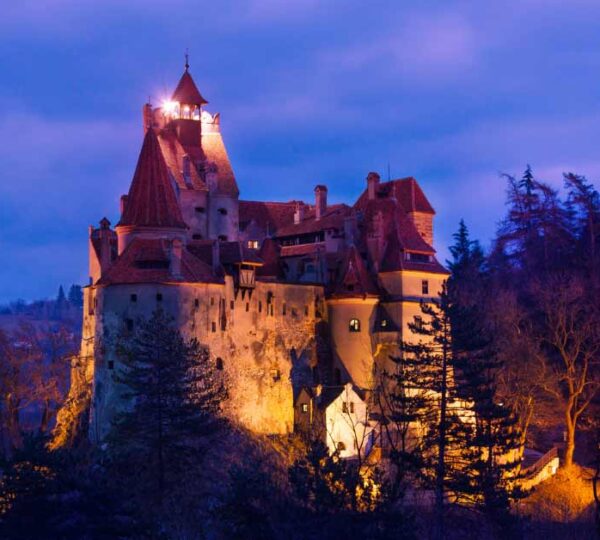
Brașov is a good city – the Black Church is extraordinary, the Schei neighborhood is interesting, and the mountain access is excellent. But the center is more commercialized now, and the Bran Castle tourist infrastructure nearby means it draws a particular kind of visitor in large numbers. Sibiu’s old town is more intact, its museums are better, the Astra is unique in Europe, and it feels less like it’s performing for tourists. You can walk all three main squares in an afternoon and still feel like you’re somewhere that exists for its own reasons, not because travelers showed up.
The exception: if you’re specifically interested in hiking or you’re planning to drive the Transfăgărășan, Brașov has a slight edge as a base for the mountain routes east. But for city-focused travel, Sibiu wins.
For a broader look at what Transylvania offers beyond both cities, our complete guide to Transylvania covers the full region in detail – from Sighișoara and the Saxon villages to the Apuseni mountains to the west. And if you’re combining Sibiu with time in Cluj-Napoca, the two cities make a natural pairing – about 2.5 hours apart by car or train.
If you’d like to visit Sibiu as part of a guided experience, we include it in our Romania tours precisely because it’s one of those places that benefits from local context – there’s a lot going on beneath the surface that you’d walk past without knowing what you were looking at. Get in touch and we’ll build something around what interests you most.