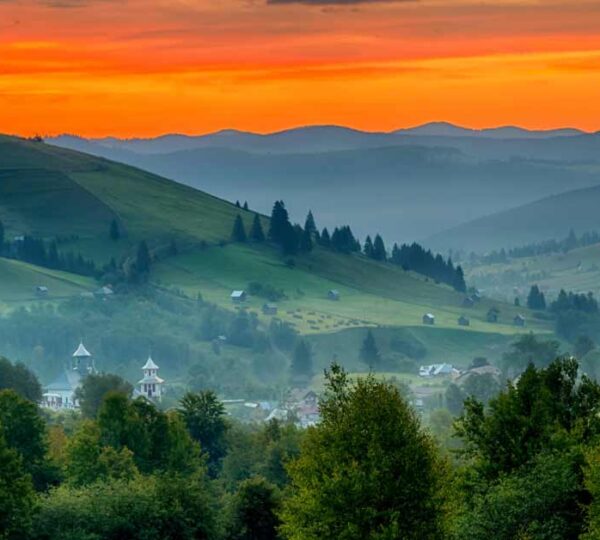

Romania has two regions I keep returning to even after years of traveling the country, and they sit at opposite ends of the north: Bucovina in the northeast, bordering Ukraine, and Maramureș in the northwest, where the hills roll toward both Ukraine and Hungary. Most travelers coming to Romania for the first time go straight to Transylvania – understandably – but I’d argue these two regions offer something that Brașov and Sibiu simply can’t: the feeling that you’ve crossed into a different century without anyone making a fuss about it.
They’re not similar to each other, which is worth saying upfront. Bucovina’s identity is bound up in its Orthodox monasteries – five of them painted on the outside with frescoes that have survived 500 years of Carpathian winters. Maramureș is more about daily life as it’s actually still lived: wooden gates, horse-drawn carts on unmarked roads, villages where people greet strangers with eye contact and don’t seem in any particular hurry. Going to both in a single trip is possible. Going to both and doing them justice takes at least a week.
How to get there
Neither region is close to Bucharest, and that’s part of why they’ve stayed the way they are.
Bucovina is centered around Suceava. By train from Bucharest, the IC connection (București Nord – Suceava) takes around 5 hours – book on cfrcalatori.ro. By car via the A1/A3 motorway to Bacău and then DN2 north, you’re looking at roughly 4.5 hours from Bucharest depending on traffic. Suceava is your practical base: it has hotels, a car rental office, and is 30-60km from most of the painted monasteries.
Maramureș is harder to reach, which is partly what preserves it. Baia Mare is the main city – around 6 hours by train from Bucharest via Cluj-Napoca, or about 5 hours by car on the A3/DN1 through Cluj. If you’re coming from Cluj-Napoca, the drive north on DN1C through Dej and then the Someș Valley to Baia Mare takes roughly 2 hours. From there, Sighetu Marmației and the key villages are another 60-80 km east.
My practical suggestion: fly into Cluj-Napoca, spend a day or two there, then drive north to Maramureș before cutting east across to Bucovina. It’s a logical arc, and it avoids backtracking. Our complete guide to Cluj-Napoca covers what’s worth your time in the city before you head north.
The painted monasteries of Bucovina
The painted monasteries are the reason most international travelers come to Bucovina, and they justify the detour. Eight of them form the main circuit; five are UNESCO World Heritage sites. What makes them unusual – and this is easy to miss if you arrive without context – is that the paintings are on the exterior walls, not just inside. They were painted this way deliberately in the 15th and 16th century so that illiterate farmers could read the biblical narratives without entering the church. The pigments used were mineral-based – lapis lazuli for the blues at Voroneț, copper compounds for the greens – and they’ve held their color across five centuries of frost and rain in a way that still puzzles conservation scientists.
Voroneț
Voroneț is the most famous and the one most people have seen in photographs. The western wall carries the Last Judgement in a blue that has no equivalent in European religious art – not quite indigo, not quite cobalt. I’ve visited it four times and it still stops me. The monastery is in the village of Voroneț, 3km from Gura Humorului. Entry fee as of 2025: approximately 10 RON; verify current pricing on site.

Voroneț Monastery
Sucevița
Sucevița is, in my view, the best of the group if you’re only going to one. It’s larger than Voroneț, better preserved on the south and north walls, and set in a valley that gives it a different quality of light in the afternoon. The fortification walls around it are also intact, which gives the whole complex a more complete sense of what these places looked like when they were built.
Moldovița
Moldovița is worth adding if you’re doing the full circuit – it’s 40km northwest of Gura Humorului and has an exceptionally well-preserved scene of the Siege of Constantinople on its south wall.
Practical note on visiting the monastery circuit: The monasteries are spread across a 60-80km corridor – you need a car to visit more than two in a day. Gura Humorului or Suceava are the natural bases. Most monasteries are open daily from around 8:00 AM to 7:00 PM in summer; hours tighten in winter. Go early in the morning in July and August – tour groups arrive mid-morning and the atmosphere changes.
Bârsana and Peri
Bârsana and Peri from Săpânța in Maramureș are a different style entirely – wooden, not painted, with the carved ornamentation typical of the region rather than exterior frescoes. Bârsana is particularly striking: a complex of wooden buildings on a hillside, built entirely without metal nails, with the spire of the main church visible from the valley road. Also worth visiting are the older wooden churches of Ieud, Poienile Izei, and Surdești – Ieud’s Church on the Hill (Ieud Deal) is one of the oldest wooden churches in Romania, dating possibly to the 14th century, and the interior paintings are intact. Our guide to Romania’s most beautiful monasteries covers the wider national context if you want to compare Bucovina and Maramureș with other regions.
Medieval citadel in Suceava
Most visitors to Bucovina treat Suceava as a transport hub and nothing else, which means they miss the Princely Court Fortress – Cetatea de Scaun – on the hill above the city. This was the residence of the Moldavian princes from the 14th century onwards, and at its peak it was one of the most strategically significant fortifications in the region. What’s left today is substantial: the outer walls are largely intact, the towers are climbable, and the views over the Suceava Valley toward the Rarău massif are the best you’ll get from anywhere in the city. Entry is inexpensive and the site is rarely crowded even in summer.

Medieval citadel in Suceava
Săpânța and the Merry Cemetery
The Merry Cemetery (Cimitirul Vesel) in Săpânța is one of those places that sounds like a tourist gimmick until you actually stand in it. The backstory: in 1935, a local woodcarver named Stan Ioan Pătraș started making grave markers that depicted the person buried beneath them in painted scenes from their life – not solemn portraits, but actual illustrations of what they did, how they died, what they were like. Each marker has a short poem in the first person, often with a dark or rueful humor about the manner of death.
The tradition has continued since Pătraș’s death in 1977. There are now over 800 of these blue-painted oak crosses in the cemetery, and walking through them is genuinely moving – partly because of the craft, partly because of the strange intimacy of knowing something real about each person. The cross for Pătraș himself, made by his apprentice, is in the center. Casa Pătraș, his workshop and home, is next to the cemetery and open as a museum – worth 20 minutes if you want to understand how the crosses are made.
Săpânța is 17km north of Sighetu Marmației on DN19. By car from Sighetu Marmației: about 20 minutes. There’s no reliable public transport on this stretch, so you need a car or a taxi from Sighetu.

The Mocănița steam train
The Mocănița narrow-gauge steam train along the Vaser Valley is one of the few working forestry railways left in Romania – the line dates to 1932 and originally served the timber industry in the mountains above Vișeu de Sus. The steam locomotive still runs on weekends from Vișeu de Sus station, following the Vaser River into a valley with no road access. The round trip to Paltin and back takes a full day – approximately 6 hours – and the scenery in the upper valley is dense Carpathian forest with no sign of infrastructure in any direction. In late September and October, the beech turns and the colors against the dark spruce are exceptional.
Practical note: tickets should be booked in advance, especially for July and August, as the train has limited capacity. Check current schedules and pricing at mocanita.ro. The departure point is Vișeu de Sus, roughly 60km east of Sighetu Marmației on DN18. Full details on the Mocănița experience – it’s worth reading before you book so you know what to expect.
Breb village
Breb is 22km southwest of Sighetu Marmației, off the main road, and it’s the village I recommend to anyone who asks where to understand what Maramureș actually is. It hasn’t been rebuilt or renovated for tourism. The main road through it is unpaved. The wooden houses behind their carved gates look the same as they would have 80 years ago, and people here are farming, not performing.
What draws visitors – and what brought Prince Charles here repeatedly, leading him to invest in restoring traditional houses – is precisely the absence of intervention. The wooden church at the center of the village dates to the 17th century. The guesthouses in Breb are family-run, the food is what the family eats, and you’ll sleep in a room where the ceiling is made of hand-hewn beams. It’s not comfortable in the way a city hotel is, but that’s not why you go.

Natural highlights: what’s worth the detour
Cascada Cailor (Horses’ Waterfall) near Borșa is the tallest waterfall in Romania – 90 meters – and accessible by cable car from the resort area. The approach by cable car takes about 10 minutes; from the top station it’s a 30-minute walk to the base of the waterfall. Go in spring or early summer when the snowmelt keeps the flow at its strongest.

TransRarău is a mountain road that climbs through Suceava County toward the Rarău massif, with views across the Bucovina plateau that are among the best in the region. It’s not as famous as the Transfăgărășan but it’s also nowhere near as crowded – in mid-September you can drive the full length without seeing another car. The road surface is variable; check conditions before going and don’t attempt it in wet weather on a rental car with summer tires.

Parcul Natural Munții Maramureșului (Maramureș Mountains Natural Park) covers roughly 148,000 hectares along the Ukrainian border and includes the Rodnei massif – one of the wilder hiking areas in Romania, with marked trails that see a fraction of the traffic that Bucegi or Piatra Craiului get in summer. The trails around Borșa and the Prislop Pass (1,416m) are accessible without technical equipment.

The Blue Lake (Lacul Albastru) near Baia Sprie is geologically unusual – it occupies a collapsed mine gallery and the copper content in the water gives it a green-blue color that photographs strangely. It’s designated as a natural monument. The hike from the parking area takes about 30 minutes. Worth an afternoon if you’re already in the Baia Mare area.

Food: what to actually eat
The food in these two regions is distinct from what you’d find in Bucharest or Transylvania, and it’s worth being specific about what to look for.
Balmoș is the dish I’d prioritize in Maramureș – a thick, cooked polenta with butter, sour cream, sheep cheese (brânză de oaie), and sometimes egg, finished over wood fire in a cast iron cauldron. The version cooked with jintiță (whey) rather than water has a sourness that changes the whole character of the dish. You’ll find it in guesthouses more than in restaurants, and the guesthouse version is always better.

Plăcintă maramureșeană is a flatbread pie filled with fresh cheese, sour cream, or potato – simpler than it sounds, and the kind of thing that’s excellent when the pastry is made that morning and nearly tasteless when it isn’t. Ask your host where to find a good one; they’ll know.
Gomboți (plum dumplings) are a regional sweet – potato dough around a whole plum with the stone removed, boiled and then rolled in toasted breadcrumbs. They appear in late summer when the plums are in season.

In Bucovina, pancakes filled with sweet cheese and dill (clătite cu brânză) and sour soups (ciorbe) made with whatever came out of the garden that day are the everyday food. Avoid the tourist restaurants immediately around Voroneț – walk 10 minutes into Gura Humorului town and the quality and price both improve significantly.
Traditional crafts
Marginea black ceramics are the one craft specific enough to Bucovina to be worth going out of your way for. The village of Marginea, 12km from Rădăuți, is the only place in the world where black ceramics are produced by natural carbonization during firing rather than through added pigments – the clay blackens in the kiln when the oxygen is cut off at the peak temperature of around 800°C. The Marginea Ceramics Center in the village is open to visitors and you can watch the production process. The pieces are functional – bowls, jugs, cups – and reasonably priced when bought directly in Marginea rather than from tourist shops in Suceava.

Marginea Black Ceramic
Wood carving in Maramureș is best understood through the gates (porți maramureșene) in front of the traditional houses – each carved with solar symbols, rope motifs, and geometric patterns that have specific meanings tied to the household’s history and social standing. The best gates in the region are in Breb, Vadu Izei, and Berbești. Ion Nița Nicoară in Vadu Izei is one of the recognized masters of this tradition, and his workshop is open to visitors by arrangement.

Vâltorile – an ingenious way to use the river for washing clothes
Where to stay
I’ll give you honest recommendations rather than a promotional list.
Village Hotel Maramureș in Breb (villagehotelmaramures.com) is the most comfortable option in the village while remaining in traditional wooden houses. It’s under English ownership, which means communication is easier, and the standard of maintenance is higher than most rural options in the area. Rates ranged from approximately 350-550 RON per night for a double – verify current pricing directly.
Green Meadows Guest House in Maramureș is a family-run pension in a traditional house – more basic than the Village Hotel but a more direct experience of how locals actually live. Booking via Booking.com.
Cabana Tinovo (tinovo.ro) is in Bucovina, in a forest setting north of Câmpulung Moldovenesc. Nordic-aesthetic cabin with sauna and hot tub – a good choice if you want comfort between long driving days visiting the monasteries.
Loft Chalet, Gura Humorului (booking.com) is a converted 100-year-old barn between Gura Humorului and Humor Monastery – five bedrooms, large garden, fireplace. Well-positioned for the monastery circuit.
Budget travelers: both regions have family guesthouses (pensiuni) in most villages for 150-220 RON per night including breakfast. Ask specifically for a room in a traditional wooden house (casă tradițională) rather than a newer concrete building – the price is often the same and the experience is entirely different.

When to go
May and June are my preference for Bucovina – the spring light on the frescoes is ideal and the monastery gardens are in bloom. Avoid Orthodox holidays (Easter, Pentecost) unless you want to witness a service, in which case go early morning.
July and August are peak season everywhere in the north. The monasteries are crowded mid-morning to mid-afternoon. If you’re going in summer, arrive at Voroneț before 9:00 AM.
September and early October are the best months for Maramureș and for the TransRarău drive – cooler, the autumn color starts, and the tourist infrastructure thins out after the first week of September.
Winter is possible in both regions – Borșa and Vatra Dornei have ski infrastructure – but the monastery circuit is bleak in December and January, and the Mocănița doesn’t run in winter. For winter travel ideas across Romania and Bulgaria, our guide to must-see places in the Balkans in winter is worth reading.

These are regions that reward slow travel. A weekend is enough to feel cheated. A week gives you time to get lost on a road that leads to a village you hadn’t planned to visit, which is where the best parts of both Maramureș and Bucovina tend to happen.
If you want to visit with a guide who knows the villages, the guesthouses, and the timing, we include both regions in our Romania tours. Get in touch and we’ll build an itinerary that makes the most of your time in the north.