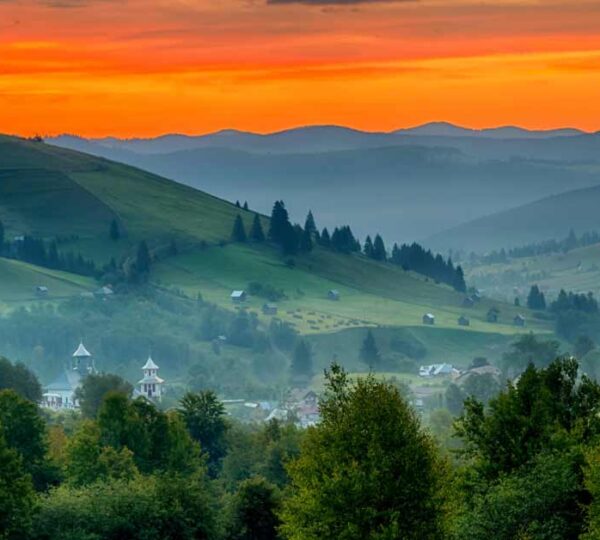

Every autumn I try to get at least one weekend up into Neamț County, and Ceahlău is usually where I end up. Romania has no shortage of mountain scenery, but Ceahlău earns its reputation for a specific reason: the massif stands on its own, separated from the main Carpathian ridge, so the view from the top doesn’t compete with a wall of higher peaks behind it.
Locals have called it the “Olympus of Romania” for centuries, and on August 6 the mountain gets its own religious feast day, Ziua Muntelui Ceahlău – as far as I know, the only mountain in the country with one.
Ceahlău National Park sits in the Eastern Carpathians, in Neamț County. This guide covers what I’d actually tell a friend before they go: which trail to pick, what the climb to Toaca really involves, where to sleep on the mountain, and what to see on the way back down through the Bicaz Gorges and Piatra Neamț.

Why Ceahlău is different
Most of what gets written about Ceahlău repeats the same handful of words: stunning, majestic, untouched. None of that tells you anything useful, so here’s what actually matters.
Ceahlău National Park is administered directly by the Neamț County Council rather than by Romsilva, Romania’s national forestry authority – it’s the only national park in the country run this way. In practice, that means the entry fee you pay at the gate (a modest, few-lei amount) funds trail upkeep and the visitor center directly, rather than disappearing into a national forestry budget.
The officially protected core covers about 7742 hectares, roughly 27 percent of the wider 290 square kilometer Ceahlău Massif. You’ll sometimes see much larger figures quoted for “Ceahlău,” usually referring to the whole massif or the surrounding communes rather than the park boundary itself. The massif is topped by two summits: Ocolașul Mare, the highest point at 1907 meters (6257 feet), and Toaca, at 1904 meters (6247 feet) – the one almost everyone actually climbs.
That’s not an accident. Ocolașul Mare sits inside the Ocolașul Mare Scientific Reserve, and general access is restricted – you can only go in as part of an organized ecotourism group, capped at nine visitors, accompanied by a park ranger. If you want the classic summit experience with open views in every direction, Toaca is the target, not its slightly taller neighbor.
The park has four official entry gates – Durău, Izvorul Muntelui, Bistra, and Neagra – each feeding a different set of trails, which is worth knowing before you commit to a starting point.
On the wildlife side, the flora is genuinely worth caring about rather than treating as a footnote. Look for Dianthus callizonus (Carpathian pink), found nowhere outside the Carpathians, and edelweiss (floare de colț) higher up. The Lady’s Slipper Orchid grows in shadier, damper patches of forest lower down.

Chamois occasionally show themselves on the Ocolașul plateau at dawn; the lynx population is close to impossible to spot outside a research context, so treat a sighting as luck rather than skill.
Capercaillie perform their mating displays here every April, if birdwatching interests you more than summits. The park administration keeps a more detailed rundown of what’s protected and why if you want to go further down that road.

Finding your trail
Ceahlău has seven officially marked trails, and Romanian trail markers combine shape and color (triangle, cross, stripe, dot), which trips up visitors used to a single-color system elsewhere. Markers get repainted over time and conditions shift, so treat everything below as a strong starting point, not gospel – confirm current markings and closures at the visitor center by the Izvorul Muntelui gate before you set out. As of January 2026, three of the routes to Cabana Dochia received official trail homologation from the park administration, which is worth knowing if you’d rather not gamble on an unofficial path in the mountains.
If you have half a day: take the blue cross trail from Durău to Duruitoarea Waterfall, about 4 kilometers one way, with a marked time of roughly 2 hours each direction, climbing to around 1250 meters. It’s the easiest well-marked route in the park and a fair introduction if you’re not planning to summit that day.
If you’re going for Toaca: the classic route runs Durău – Cabana Fântânele – Toaca – Cabana Dochia, marked with a red stripe. It’s officially posted at about 7.5 kilometers and 3 to 3.5 hours, but that number assumes a brisk, non-stop pace. Realistically, budget 5 to 6 hours one way once you factor in the summit stairs and an actual break at the top, and 8 hours or more for a round trip back to Durău the same day. This is the gap between marked times and lived experience that a lot of trail signage in Romania glosses over.

Coming from the Bicaz side instead: the eastern approach from Cabana Izvorul Muntelui, through Poiana Maicilor, to Cabana Dochia is also marked with a red stripe (a different trail from the one above, since Romanian markers repeat across separate trailheads rather than being unique nationwide) and runs about 4.5 hours, gaining around 950 meters. It’s the better pick if you’re based near Bicaz rather than Durău.
Toaca Peak and the 519 steps
Toaca is the peak nearly everyone means when they say they “climbed Ceahlău.” The final push is a staircase – 519 steps, recently restored and in solid condition – leading up to the old weather station at the summit. It’s steep in places with no shade, so start early if you’re doing this in July or August.
At the top, on a clear day, you can pick out the Bistrița range to the north and the Rarău and Giumalău peaks in the distance. Hikers who overnight at Dochia and time their morning right sometimes catch what locals call the “alpine sea” – a thick layer of cloud that fills the Izvorul Muntelui valley at sunrise while the summits stay clear above it. I’ve missed it twice now by oversleeping. Third time’s the plan.
If you’re staying over, Cabana Dochia, just below the summit, is the only accommodation actually on the mountain. As of early 2026, a double room with private bathroom runs around 590 RON, a triple around 790 RON – these change, and bookings mostly happen by phone rather than online, so confirm current rates directly through cabana-dochia.ro before you go. The bar and kitchen keep their own hours, roughly 7:30am to 9pm and 8am to 8pm, and one house rule that catches people off guard: trekking poles and crampons aren’t allowed inside the cabin itself.
Exploring the natural wonders around Ceahlău
Bicaz Lake (Izvorul Muntelui)
Locals call it Lacul Izvorul Muntelui more often than “Bicaz Lake.” It’s the largest reservoir in Romania, created when the Bicaz Dam was built between 1950 and 1960 on the Bistrița River. Near the dam there’s a small harbor where you can rent a rowboat or take a short cruise on the lake, a reasonable way to fill an afternoon if a full hike isn’t on the schedule that day.
Bicaz Gorges
Cheile Bicazului is the reason most people take this route at all, hikers or not. The road through it, DN12C, runs about 8 kilometers between Bicaz and Gheorgheni, with limestone walls reaching up to 300 meters on either side. The narrowest, most dramatic stretch has its own name: Gâtul Iadului, “Hell’s Throat.” There’s a tunnel built in 2005, 155 meters long and 6.8 meters high – worth knowing if you’re driving anything tall, a camper especially.
One honest warning: sections of DN12C near kilometer 33 to 34 had active landslide and rockfall problems as recently as May 2025, serious enough that the county prefecture sent an inspection team. Roadwork gets done, but check current conditions before committing to the drive, especially after heavy rain.
The gorges also mark a county line. Drive through them and you cross from Neamț County into Harghita County, from Moldavia into Transylvania, which is part of what makes this stretch feel like more than scenery.

The Red Lake
Lacul Roșu sits just past the gorges, technically in Harghita County, formed in 1837 when a landslide off Mount Ghilcoș blocked the valley (some geologists argue for 1838, tied to a regional earthquake, though 1837 is the year you’ll see most often). It sits at 983 meters, and the most striking thing about it isn’t the color – it’s the submerged, petrified fir trunks still standing in the water from the forest the lake drowned when it formed. You can rent rowboats at the shore, and the Panorama Restaurant overlooking the water is still serving a mix of Romanian and Hungarian dishes, a fair reflection of exactly where you’ve ended up.
One honest caution before you go wandering off toward the woods here or around the gorges: this area sees regular brown bear activity, especially at dawn and dusk. See the practical notes near the end of this guide before you set off alone.
Historical and cultural sites near Ceahlău
Neamț Fortress
Cetatea Neamțului dates to the late 14th century, built under Prince Petru I and then reinforced by Ștefan cel Mare between 1457 and 1504, who raised the walls by roughly 6 meters. It sits on Stânca Timuș, part of Culmea Pleșului, at 480 meters, above the town of Târgu Neamț.
You can’t drive up to it. There’s a 15 to 20 minute walk up a paved forest path from the parking area, and the entrance itself crosses a footbridge over the old moat, a good reminder that this was a working defensive structure once, not a viewpoint built for tourists. Restoration work between 2007 and 2009, funded through EU programs, is why it’s in decent shape today rather than a ruin.
It’s closed on Mondays. Hours run roughly 9am to 5pm in the cold season (October to March) and 10am to 6 or 7pm from April to September, though it’s worth checking ahead since the exact times shift by season. Entry runs about 24 RON for adults, less for students and children. If fortified sites interest you beyond this one, our guide to Romania’s castles and fortresses covers several more within a few hours of here.
Popa Târpești House
About 10 kilometers from Târgu Neamț, in the village of Târpești, is what’s properly called the Nicolae Popa Ethnographic Museum – built by the folk artist Nicolae Popa (1919-2010) in his own courtyard and open to the public since 1977. It’s grown to twelve themed rooms covering ethnography, naive painting, numismatics, traditional costumes, religious art, and household objects, along with archaeological pieces recovered from the Neolithic settlement excavated at Târpești itself – a detail most visitors don’t expect from what looks, from the road, like a private house.
If you’re heading this way anyway, it pairs naturally with Neamț Fortress for one afternoon.
Piatra Neamț
Piatra Neamț, nicknamed the “Pearl of Moldavia,” sits at the foot of the Carpathians and makes a sensible base for the last night of a Ceahlău trip. In the historic center, Stephen the Great’s Tower dates to the 15th century and gives a solid view over the town.
What most articles call a “cable car” up Cozla Hill is actually a gondola (telegondola) – the only one in Romania that runs from a train station, across an entire city center, up to a mountain top. Since opening in February 2008 it has carried well over a million passengers, climbing 309 meters in about 8 minutes, with tickets running around 25 RON as of early 2026.
For dinner, I go to Berăria Nenea Iancu on Bulevardul Republicii 5, open daily until midnight, for their own unfiltered house beer and a plate of mici. It isn’t fancy, and that’s exactly the point.

The tower of Stephan the Great – in the central square
Practical tips for visiting Ceahlau Mountains
Best time to visit
June through September is the reliable window for the higher trails, once snow clears from the north-facing sections near Panaghia and Toaca (these can hold ice into late spring in some years). Late September into October brings the best light for photos and noticeably fewer people on the trail, though nights turn cold fast at altitude. Winter turns this into a ski destination centered on Durău instead, with the high routes to Dochia reserved for people who genuinely know winter mountaineering.
If you can time a trip around it, August 6 is Ziua Muntelui Ceahlău, a local mountain festival held in Durău and apparently the only mountain feast day of its kind in the country. Visiting in spring instead? What to pack for Romania in spring is worth a look before you leave, since layering matters more here than the forecast suggests.
How to get there
Four national roads reach the wider Ceahlău tourist zone: DN15B from Târgu Neamț in the northeast, DN17B from Bistrița and Vatra Dornei in the north, DN15D from Gheorgheni through the Red Lake and Bicaz in the southwest, and DN15 from Piatra Neamț through Bicaz from the east. Durău and Cabana Izvorul Muntelui are the two main trailhead towns, on the northwest and east sides of the massif respectively. If you’re continuing north from here rather than back south, that DN17B route also connects toward the painted monasteries of Bucovina, roughly half a day further on.
From Bucharest, plan on 5 to 6 hours of driving, depending on the route and how the Bicaz road is behaving that week. By train, CFR doesn’t run a direct fast service into this corner of Moldavia – check current connections on CFR Călători before assuming a route exists, since most journeys involve at least one change and can run 6 hours or more. That’s why I generally point people toward driving or a long-distance bus instead of the train for this specific trip.
The nearest airport is Bacău (“George Enescu” International, code BCM), roughly 120 kilometers away, about 2 to 2.5 hours by car – a reasonable option if you’re arriving from elsewhere in Europe rather than driving up from Bucharest.
Where to stay
Camping inside the park is only allowed in designated sites after paying the camping fee; open fires are banned throughout the park, and dogs must stay leashed. If a cabin bed beats a tent, Durău, Bicaz, and Piatra Neamț all have guesthouses and small hotels across a range of prices, and Cabana Dochia (details above) is the only option actually on the mountain itself.
If Ceahlău is one stop on a longer Romania trip, our Romania and Bulgaria budget guide lays out realistic price ranges for accommodation, food, and transport across the wider region.

Dochia Cabin
A note on bears
Neamț County has a genuine brown bear population, and you’ll see warning signs on some trails. The practical guidance, based on advice from WWF Romania and Salvamont: hike in a group where you can, and make noise on the trail – talking, whistling, or a bell on your pack all work, since bears generally avoid people they hear coming from a distance. If you do encounter one, don’t run.
Back away slowly without turning your back, and never put yourself between a mother and her cubs. Capsaicin-based bear spray is legal in Romania and worth carrying in bear country, though it only works at close range and needs a reasonably large canister to be effective. Keep any dog leashed. In a genuine emergency, call 112.
Plan a Ceahlău trip with Balkan Trails
Ceahlău rewards people who show up with an actual plan rather than a photo list: pick your trail based on fitness and the day’s weather, book Dochia ahead if you want to sleep on the mountain, and leave a full day free for the Bicaz Gorges, Red Lake, and Piatra Neamț loop on the way back down.
If you’d rather hand off the logistics, we run guided tours through this exact route, with transport, lodging, and a local guide arranged in advance. Get in touch and we’ll build the itinerary around the pace you actually want to hike at.