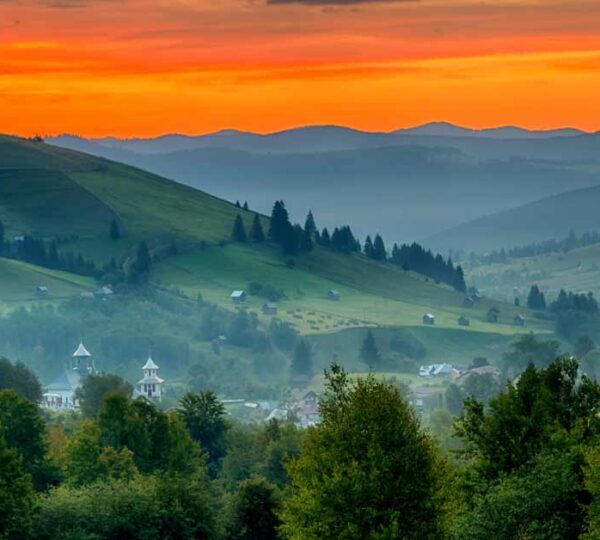

Romania’s spring runs cold-to-mild across three genuinely different months, and packing for “spring” as one blanket season is how people end up either freezing in Brașov or sweating through a wool sweater in Bucharest. Here’s what I’d actually pack, broken down by what changes month to month.

The Romanian weather in spring
March runs cold: Bucharest averages roughly 32 to 55°F (0 to 13°C), and Brașov and the other mountain towns stay colder still, often 25 to 46°F (-4 to 8°C). I’ve gone into more depth on March specifically, weather, traditions, and the honest trade-offs, in my guide to visiting Romania in March.
By April, Bucharest climbs to about 43 to 66°F (6 to 19°C), with Brașov trailing a few degrees behind, and May is the first properly mild month, Bucharest reaching into the low-to-mid 70s°F (low-to-mid 20s°C) on a good day, though nights can still dip into the 40s°F. These figures are drawn from long-term seasonal averages rather than any single year, so treat them as a planning baseline, not a forecast.
Anywhere at altitude, Bucegi, Piatra Craiului, the higher Carpathian trails, snow and near-freezing temperatures are normal well into spring regardless of what the lowland forecast says. One honest caveat: surprise late-season snow or frost in April isn’t rare, so don’t fully retire the warm layers even if you’re traveling in supposedly “late spring.”

Daytime basics
Keep it simple and practical rather than trying to match a specific local style: jeans or comfortable pants, a few T-shirts, a sweater, a rain jacket, and a thicker sports jacket or hoodie for the colder weeks. Sneakers cover most city walking; ankle boots handle cobblestones and the inevitable damp morning better than anything lighter. You’ll be on your feet a lot, walking between sites, using public transport, wandering through dusty fortress courtyards, so comfort matters more than style here.
A reasonable spring packing list:
- 2-3 T-shirts or long-sleeve base layers
- 1 sweater or fleece mid-layer
- 1 waterproof or water-resistant rain jacket
- 1 warmer jacket or hoodie for evenings and the colder weeks (March especially)
- Jeans or comfortable pants (2 pairs is usually enough)
- Sneakers plus one pair of sturdier ankle boots
- A beanie and light gloves if you’re traveling in March or early April
- A small umbrella or packable rain shell

Hiking gear, if that’s part of the plan
Hiking is a real reason people come to Romania in spring, and it needs its own packing logic. Bring waterproof layers, real hiking boots rather than sneakers, and a jacket with a hood and decent lining, spring weather in the mountains changes fast. A windbreaker, a sweat-wicking base layer, and a fleece mid-layer cover most conditions; add a buff and sunglasses, since sun exposure at altitude is real even when the air is cold.
If you’re heading into Bucegi or Piatra Craiului specifically, remember that trails above roughly 1500 meters can still hold snow and ice deep into spring, even when the trailhead itself looks perfectly clear, so check current conditions before committing to a route rather than assuming the calendar means the mountain has caught up. For packing the bag itself, REI’s loading guide is worth five minutes if you haven’t done a multi-day hike before.

Evenings
For a simple evening walk, a warm jacket and a beanie aren’t optional, temperatures drop fast once the sun’s down, even in May. This is especially true in mountain towns like Brașov, where evening cold sets in earlier than the daytime forecast suggests. The same goes for most of the fortified Saxon towns in the region. Sibiu and Sighișoara run similarly cold after dark. For restaurants or a night out, Romanians generally dress a notch smarter than daytime casual, so packing one slightly nicer outfit, jeans with a blazer or a simple dress, covers most situations without needing a full second wardrobe.

What women should know about dress codes
There’s no general dress code for visiting Romania as a woman, day to day, wear what you’d wear anywhere else in Europe. The one place it matters is religious sites: churches and monasteries generally expect covered shoulders, and some ask women to cover their heads with a scarf, though this varies by site and isn’t universally enforced. A long skirt or scarf packed in your bag covers you if you end up somewhere with shorts on a hot afternoon and a monastery on the itinerary.

If you’re building a trip around Bucovina’s painted monasteries or other religious sites, I’ve covered the specific etiquette expectations in more detail in my guide to Romania’s most beautiful monasteries. If you don’t have the right item on hand, don’t stress about it; people are generally understanding, and it’s about respect rather than a hard rule.
A few other things worth packing
A small umbrella, a quick-dry towel, comfortable slippers for guesthouses that expect shoes off indoors, and a pair of sandals in case a warm afternoon catches you off guard, especially by late May. None of this needs to be expensive or specialized; it’s mostly about covering the range of weather spring actually delivers rather than the range the word “spring” implies.

If you want the fuller picture on safety before you go, I’ve written a separate guide on that. And if you’d rather have someone build the itinerary around your dates so you know exactly what weather to pack for, reach out to Balkan Trails and we’ll sort the logistics with you.