
I get asked fairly often which Romanian monastery is “the one to see,” and I never have a clean answer, because the five I’d actually send someone to aren’t really comparable.
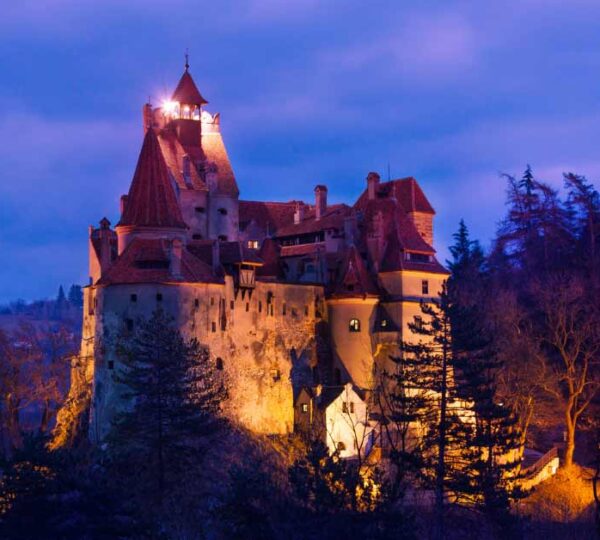
One is a burial site for a medieval prince, one is famous for a single shade of blue, one is technically two buildings that most articles describe as one, one holds the tombs of a king and a queen most people know from Peleș Castle, and one has a legend gruesome enough that I still think about it every time I drive past. Romania’s most-told legend is Bran Castle’s Dracula story, but honestly, a couple of these monastery legends are darker.
A few practical things before the list, since most articles skip them entirely: these monasteries are almost all still active religious sites, not museums, so modest dress matters, women are generally expected to cover their shoulders and sometimes their heads, and most sites keep a wrap or scarf at the entrance if you show up unprepared.
Entry is typically free, with a donation box rather than a ticket booth, though photography sometimes carries a small separate fee. And they’re spread across four different regions, so don’t assume you can casually add all five to one trip.
1. Putna Monastery
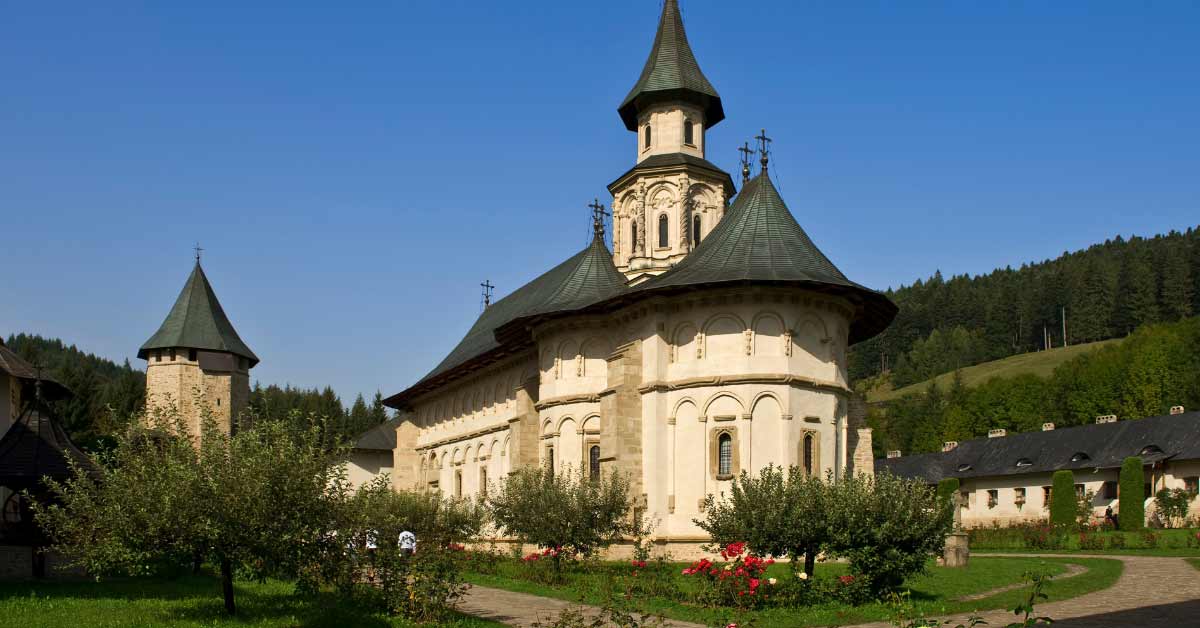
Putna is where Stephen the Great, Moldavia’s most consequential medieval ruler, is buried, and the monastery exists largely because of him. He laid its foundations between 1466 and 1469, reigned for 47 years, and was buried on the grounds in 1504.
Worth being clear about upfront: Putna is not one of the eight UNESCO-listed Painted Churches of Moldavia (that’s a distinct designation covering Voroneț and seven others), but it’s arguably more historically central to Romanians than any of them, sometimes called “the Jerusalem of the Romanian people.”
The Treasure Tower has stood unaltered since Stephen’s time. The Bell Tower and Eminescu’s Tower add a literary footnote: Mihai Eminescu, Romania’s national poet, is said to have stayed there occasionally. Putna sits in Suceava County, in Bucovina, the same corner of the country as Voroneț, so the two combine naturally into a single day if you’re already in the region.

2. Voroneț Monastery
Voroneț was built in 1488 and, according to local tradition, completed in three months, three weeks, and three days, a construction timeline chosen for its symbolic weight in Christian numerology rather than because anyone was in a hurry. It’s one of the eight churches that make up the UNESCO World Heritage “Churches of Moldavia” listing, alongside Humor, Moldovița, Sucevița, Arbore, Pătrăuți, Probota, and Saint John the New in Suceava. If you’re building a Bucovina itinerary around Voroneț, those seven are the natural additions, most within an hour’s drive of Suceava, and I’d rather see someone do three of the eight properly than rush all eight.
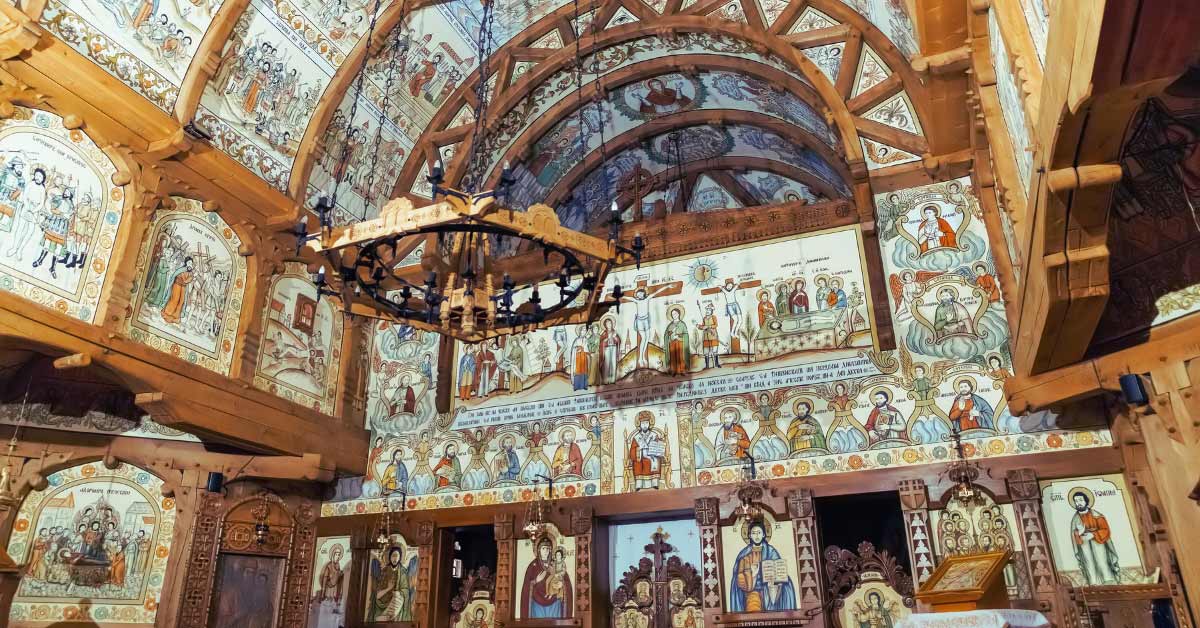
The exterior murals have held their color through five centuries of weather with no confirmed record of what the original pigments actually were, which is either a genuine mystery or a well-kept trade secret, depending who you ask. The Last Judgment fresco on the west wall, painted on a wall with no doors or windows, deliberately left blank for exactly this purpose, earned Voroneț the nickname “the Sistine Chapel of the East.” The specific shade used throughout is now known internationally as “Voroneț blue.”
The legend behind it
In 1476, Stephen the Great was on the losing end of a battle against the Ottomans at Valea Albă and reportedly ready to give up. A hermit named Daniil convinced him to fight on under Saint George’s banner. Stephen won, and Voroneț was his promised thank-you to Daniil, built in Saint George’s honor. The pope later gave Stephen the title “Athlete of Christ” for it.
3. Bârsana Monastery
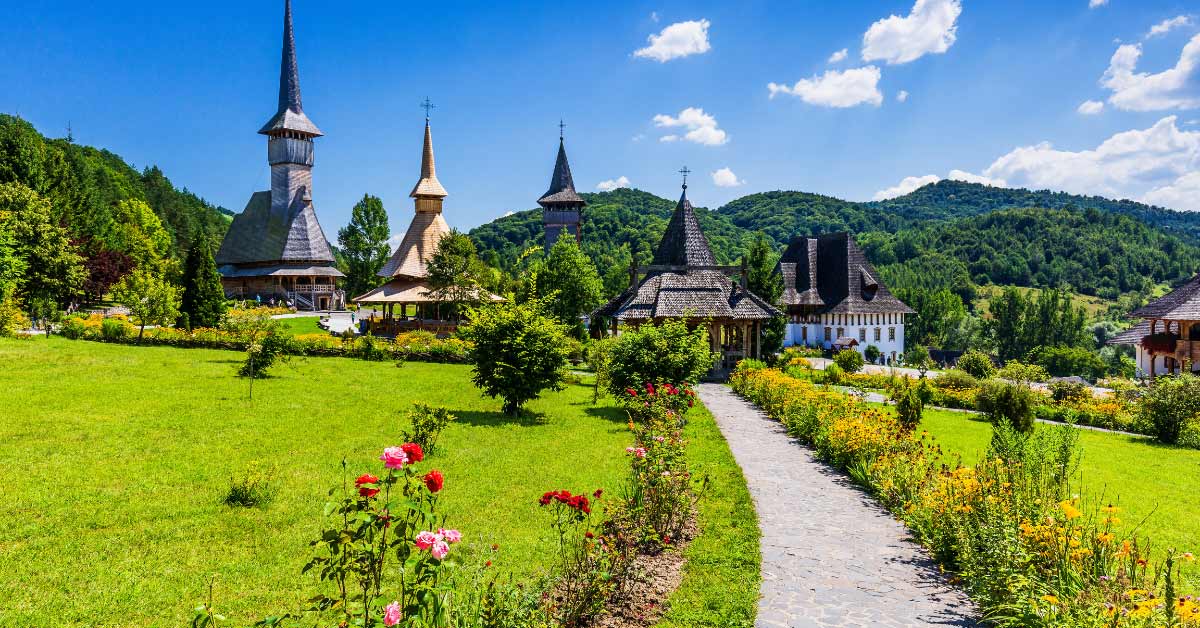
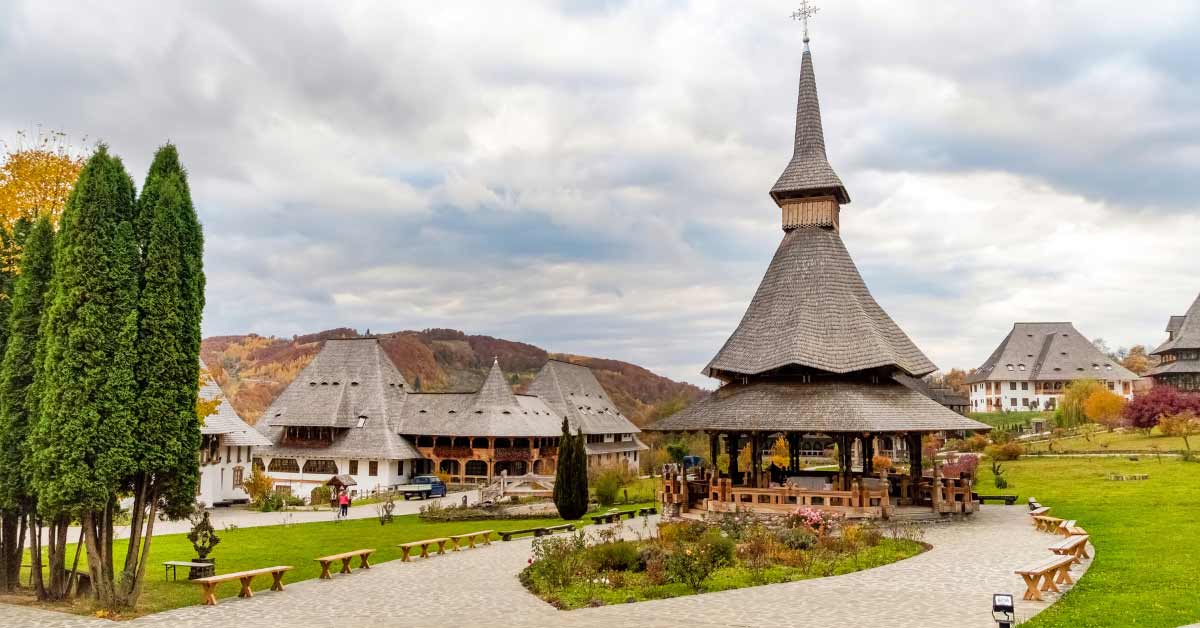
Bârsana gets more day-trip traffic than almost anywhere else in Maramureș, and most visitors leave without realizing the village actually holds two separate wooden structures that get talked about as one. The UNESCO-listed building is an older wooden church, built in 1720 and relocated to its current spot on Jbar Hill in 1806, standing roughly 57 meters tall, one of the tallest wooden church towers in Europe. It sits at the western edge of the village and now functions as a museum.
The monastery complex itself, on the eastern side, centers on a newer worship church built between 1993 and 1995, about 22.5 meters long and 12 meters wide, with its own bell tower. Sources online routinely merge the two into a single set of statistics; I’d treat the 57-meter figure as belonging to the historic UNESCO church specifically, not the newer one.
Documented history here goes back to 1326, when King Carol Robert confirmed ownership rights over the Barsana estate, with the church itself first recorded in 1390. The active monastery still holds regular services; the old wooden church operates as a museum. Bârsana sits inside Maramureș, a region with roughly a hundred wooden churches in total, eight of them UNESCO-listed, so it’s worth treating as one stop on a wider wooden-church route rather than the whole point of the trip.
4. Trei Ierarhi Monastery
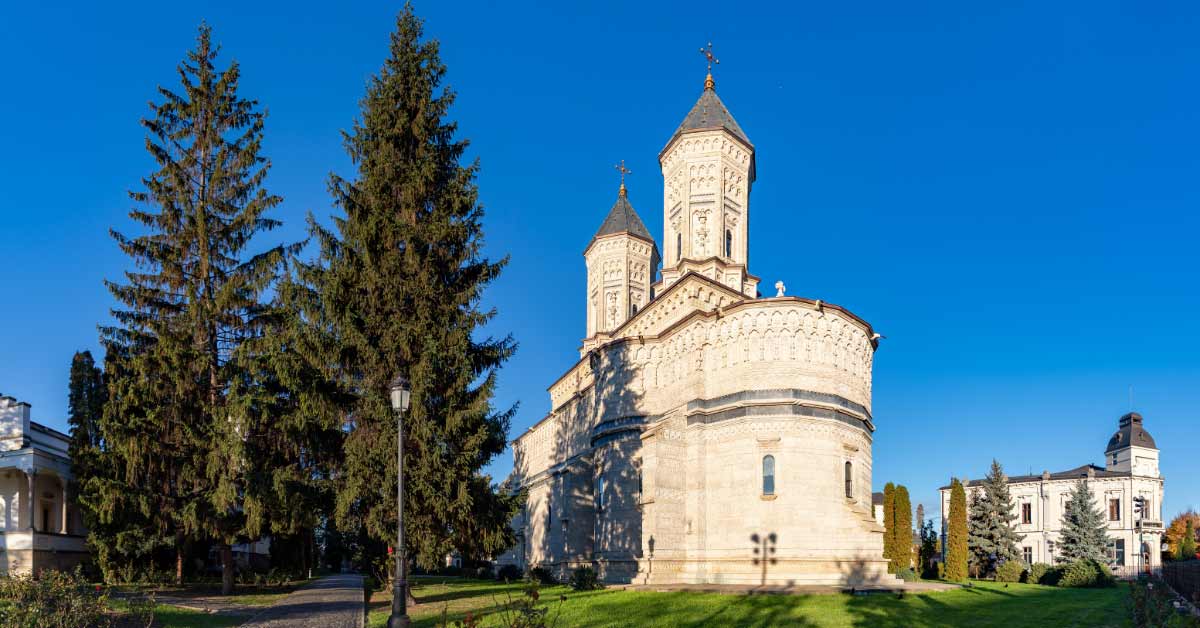
Trei Ierarhi, in the center of Iași, was Moldavian ruler Vasile Lupu’s personal architectural statement, built between 1637 and 1639 and consecrated that May by Metropolitan Bishop Varlaam. What sets it apart is the exterior: over 30 non-repeating bands of carved stone ornament running from base to roofline, blending Gothic and Renaissance elements with Armenian, Georgian, Persian, and Ottoman decorative traditions into something that doesn’t really have a direct equivalent elsewhere in Romania.
The church held the relics of Sfânta Cuvioasa Parascheva from 1641 until 1889, when they were moved to Iași’s Metropolitan Cathedral nearby. A long restoration under French architect André Lecomte du Nouy, running from 1882 into the early 1900s, replaced most of the original interior painting; surviving fragments are on display in the adjacent Gothic Hall.
The church’s tombs are arguably a bigger draw than most articles mention: Vasile Lupu himself is buried here, alongside Prince Dimitrie Cantemir and Alexandru Ioan Cuza, the ruler who unified Moldavia and Wallachia into modern Romania in 1859.
5. Curtea de Argeș Monastery
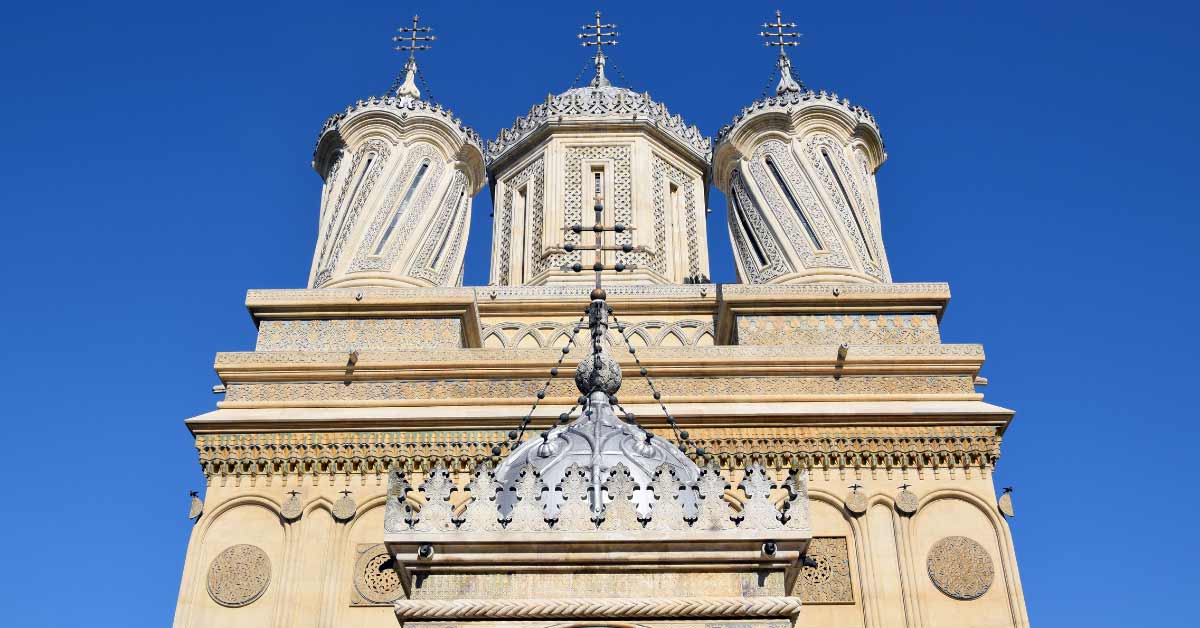
Curtea de Argeș, once the capital of feudal Wallachia, is a small city with an outsized history, and its monastery is the reason. Prince Neagoe Basarab commissioned it in 1512, and it was consecrated in 1517; the current appearance is largely the result of a 19th-century restoration, again under Lecomte du Nouy, after earthquakes and fires had left the complex close to ruin. It’s not a castle, but the royal connections here are strong enough that it belongs on the same mental map as Romania’s castles and fortified towns.
That connection becomes obvious once you know who’s actually buried inside. Under King Carol I, the church became the royal necropolis: Carol I and Queen Elizabeth are buried here, alongside King Ferdinand I and Queen Marie, the same Ferdinand and Marie whose personal wing at Peleș Castle in Sinaia I’ve written about separately. It’s a strange thing to register in person: the royal couple whose taste shaped a summer palace in the Carpathians ends up resting in a small Wallachian town most visitors have never heard of.
The legend of Master Manole
The most famous version of the story goes like this: a ruler summoned skilled craftsmen to build the monastery, but the walls collapsed every night. In a dream, master builder Manole learned the structure would only hold if he walled his own wife, Ana, into it. He did, building her into the south wall. Impressed and paranoid in equal measure, the ruler then stranded the craftsmen on the roof to stop them from replicating the feat elsewhere. Manole built himself wings from a sieve and jumped rather than stay trapped; he died in the fall, and his tears are said to have formed a spring near the monastery.
A separate legend belongs to Saint Filofteia, whose relics rest in the monastery’s chapel: a young girl who gave her father’s workers’ food to beggars instead, was killed by her own father for it, and whose body reportedly couldn’t be moved until the monastery’s name was invoked over her.
If you visit in spring, the monastery’s magnolia garden is worth timing your trip around; it’s a small, unpublicized detail that most listicles about the place skip entirely.
History aside, what actually connects these five is that none of them read as generic once you know the specifics: a 47-year reign, a three-week construction sprint, a UNESCO statistic that’s been misattributed for years, a set of tombs that ties back to a royal family most people only know from a different castle, and a legend gruesome enough to still get told at dinner tables.
If any of this has you thinking about a longer Romania trip, Balkan Trails can help put one together, monasteries included. Most people end up combining two or three of these five rather than chasing all of them in one go, and that’s usually the better trip anyway. Reach out directly and tell us which ones actually fit your route, and we’ll start planning your tour of Romania from there.