
Iași doesn’t get the visitor numbers that Brașov or Sibiu do, and honestly, that’s part of why I keep sending people there. It sits in Romania’s northeast, close to the border with the Republic of Moldova, and it spent centuries as the political and cultural center of Moldavia – not to be confused with the modern country of Moldova next door, a mix-up I hear constantly. Moldavia was the historical Romanian principality; Iași was its capital.
That history is still physically present here in a way it isn’t in most Romanian cities: a carved monastery that housed the region’s first printing press, a university hall wallpapered in surreal blue murals, and a park older than the Romanian state itself. This guide covers what I’d actually tell a friend before a trip here, not just a list of things that look nice in photos.

The city centre – the gardens behind the Palace of Culture
A glimpse into the history of Iași
Iași was the capital of the Principality of Moldavia from the 16th century until 1859, when it lost that status to the newly unified Romanian state. The lead-up to that union is worth knowing about if you’re standing in the city center: on January 5 1859, Alexandru Ioan Cuza was elected ruler of Moldavia in Iași – three weeks before he was elected ruler of Wallachia in Bucharest on January 24. That double election is what created modern Romania, and it started here, not in the capital that eventually took over.
Iași also has a real claim to the birth of Romanian-language media. Gheorghe Asachi launched “Albina Românească” here on June 1 1829, the first Romanian-language newspaper published in Moldavia (Bucharest’s “Curierul Românesc” beat it by about six weeks, so the more accurate claim is “first in Moldavia,” not “first in Romania,” despite what you’ll read elsewhere). Between the newspaper, the university, and the literary societies that followed, Iași built a genuine claim to the title “Cultural Capital of Romania” well before tourism marketing got hold of the phrase.
Getting to and around Iași
The original version of this guide never actually explained how to reach Iași, which is worth fixing first. Iași International Airport (IAS) sits about 8 kilometers east of the city center, is one of the oldest certified airports in the country, opened in 1926, and is now the third-busiest airport in Romania by passenger traffic, with Wizz Air running it as a focus city. By train from Bucharest, direct CFR services take roughly 6 hours 20 minutes to 6.5 hours over about 403 kilometers, and there’s no meaningfully faster rail option, so weigh that against a domestic flight if time matters more than budget.
Public transport within the city runs through CTP Iași, and it’s genuinely easy to use: buses and trams cover the whole city, and routes are well signed for anyone visiting for the first time.
As of a early 2026 fare increase, a single ticket (valid 120 minutes, one journey) costs 4 RON, and a two-journey ticket costs 8 RON. If you’re staying a few days, a one-day pass runs about 13 RON, and CTP also sells a 3-day tourist pass covering every route and vehicle for 30 RON, which is the better deal if you’re sightseeing rather than commuting. A monthly pass, if you somehow need one, runs 250 RON. Prices here get adjusted periodically, so treat these as a solid ballpark rather than gospel.
Taxis are metered and reasonably priced by Western European standards, and ride-hailing apps like Bolt operate in the city too, which tends to be the easier option for late-night trips or when you don’t want to negotiate a fare. A short ride across the center will generally cost a few RON to a few dozen, depending on distance and time of day.
If you want the fuller picture on personal safety, road conditions, and general precautions across the country rather than city by city, our dedicated guide on safety in Romania covers it in more depth than a paragraph here could. The short version for Iași specifically: it’s a university city with a strong police presence downtown, and normal city precautions cover you.
What to visit in Iași
The Hall of Lost Steps
The Hall of Lost Steps, Sala Pașilor Pierduți, sits inside the University Palace at Copou and is worth the detour even if you have no interest in universities generally. The hall mixes Neo-Gothic and Renaissance Revival detailing, but what people actually come for are the 19 murals painted by Sabin Bălașa, covering roughly 300 square meters of wall space, done in an a secco technique (painted onto dry plaster, not wet, technically different from a true fresco) and dominated almost entirely by blue.
One honest note: as of early 2026, these murals are in a documented, worsening state of deterioration, and restoration has stalled for years over an unresolved ownership dispute between the two universities that share the building. It’s still worth seeing, but I wouldn’t wait another decade to go.
“Vasile Alecsandri” National Theatre
Iași’s National Theatre is Romania’s oldest, founded in 1840 under a trio of Vasile Alecsandri, Costache Negruzzi, and Mihail Kogălniceanu. The original building at Copou burned down completely in a fire on the night of February 17-18 1888, and the current building, finished in 1896, was designed by Fellner & Helmer, the Viennese firm responsible for dozens of European theaters and opera houses of the same era.
Their signature contribution here, as elsewhere, was an iron fire safety curtain they pioneered specifically to stop theaters burning down the way this one had. It’s a working theater with a regular program, not a museum piece, so check what’s actually on rather than just touring the lobby.
Lăpușneanu Street
Lăpușneanu Street is the pedestrian spine of central Iași, lined with older buildings now holding bookshops, antique dealers, cafes, and a scattering of art galleries. It connects the university area to the Palace of Culture, so you’ll likely walk it regardless of whether you plan to stop, which is honestly the appeal: it’s a street built for walking slowly rather than a single destination in itself.

Three Holy Hierarchs Monastery
This is the building I’d prioritize if you only have time for one stop. Built by Voievod Vasile Lupu between 1637 and 1639, the Trei Ierarhi church has an exterior carved, top to bottom, in 30 horizontal bands mixing Gothic, Baroque, Byzantine, and Caucasian and Persian motifs – not a single section repeats the same pattern, and there’s genuinely nothing else quite like it in the country.
Inside, Vasile Lupu is buried here alongside his family, as is Alexandru Ioan Cuza and the Moldavian prince and scholar Dimitrie Cantemir. The site also has a real claim to being a birthplace of Romanian print culture: in 1640, Vasile Lupu founded the Academia Vasiliana on the grounds, and Moldavia’s first printing press operated here, producing “Carte românească de învățătură” in 1643, one of the earliest printed books in the Romanian language.
If monasteries and fortified religious architecture interest you elsewhere in the country, our guide to Romania’s most beautiful monasteries covers several more, including the painted monasteries a few hours north in Bucovina.

Places to see if you love nature
The Botanical Garden
Founded in 1856 by the physician and naturalist Anastasie Fătu, this is the oldest botanical garden in Romania and, at roughly 100 hectares on Copou Hill, one of the largest in Europe. It’s organized into about 10 thematic sections (Romanian native flora, a rose garden, a dendrarium, greenhouses, and others) and holds close to 10000 plant taxa.
There’s also a section designed for blind visitors, with tactile labels and Braille signage, a detail worth knowing if you’re traveling with someone who’d benefit from it. Check the garden’s schedule before visiting, since hours shift by season and some greenhouses close for maintenance periods.
Copou Park
Here’s a correction worth making up front: Copou Park is not the sprawling green space some guides describe. It’s about 10 hectares today, small enough to walk end to end in fifteen minutes, though it was larger at its 19th-century peak before the city grew around it. What it lacks in size it makes up for in significance: it’s the oldest public park in Romania, laid out starting in 1834 under Prince Mihail Sturdza.
At its center stands the Lions’ Obelisk, built in 1834 and finished in 1841 to designs by Gheorghe Asachi – the same man behind that first newspaper – commemorating the Regulamentul Organic, an early proto-constitutional law for the Romanian principalities. It’s considered the first public monument raised in the Romanian Principalities, which is a fairly serious claim to fame for a 13-meter stone obelisk most visitors walk past without a second look. Eminescu’s Linden Tree and a small museum dedicated to the poet are here too, alongside a row of busts honoring other figures from Iași’s literary circles.
Entry is free, and it’s a good place to sit rather than a destination to plan around.

Modern sites with a twist of history
The Palace of Culture
The Palace of Culture took nearly two decades to build, from 1906 to 1925, on the site of Moldavia’s former medieval princely court. It’s the most significant work of architect I.D. Berindey, trained in Paris, and its 55-meter central tower made it the tallest building in the city when it opened. A small detail that catches most visitors off guard: the clock in the tower plays “Hora Unirii,” the Union anthem, on an eight-bell carillon every hour on the hour.
It now houses four museums under the Complexul Muzeal Național “Moldova”: an Art Museum with close to 10000 works, a History Museum of Moldavia, an Ethnographic Museum of Moldavia with over 13000 pieces covering traditional rural life, and the Science and Technology Museum “Ștefan Procopiu.” Hours run roughly 10am to 5pm most days, extending to 6pm on Friday and Saturday, though it’s worth confirming the current closing day before you go, since museum schedules here shift more often than the palace’s own opening hours.

Palas Mall
Palas Mall sits directly behind the Palace of Culture, but it’s worth knowing it’s part of something larger: the whole Palas complex opened in 2012, a 270000 square meter, roughly 265 million euro development built through a public-private partnership between Iulius Group and the Iași City Council, the kind of mixed retail-office-public space project that was genuinely new for Romania at the time. Beyond the shops, there’s a 50000 square meter public garden behind the Palace of Culture, Grădina Palas, which is a nicer spot for a coffee break than the food court if the weather’s decent.
Where to stay in Iași
Three recommendations, depending on what you’re after:
Hotel International Iași is the upscale choice, with a spa, fitness center, and in-house dining, positioned within easy reach of the main sights.
Unirea Hotel & Spa sits right in the center, with an indoor pool, wellness area, and rooftop restaurant. Location is the main draw here: you can walk to most of what’s in this guide.
Pleiada Boutique Hotel is smaller and more personal, with gourmet dining and spa services if you’d rather not stay somewhere the size of a small airport terminal.
If you’re planning Iași as one stop on a longer Romania trip, our Romania and Bulgaria budget guide has realistic price ranges for accommodation and food across the wider region.
Where to eat in Iași
For traditional Romanian cuisine, La Conac does a good, unfussy version of sarmale (cabbage rolls) and mici (grilled minced-meat rolls) in a rustic setting. One dish worth asking for that isn’t on most tourists’ radar: plăcinte, savory or sweet stuffed pastries that are more of a genuine Moldavian staple than either of the two dishes above, which are common across the whole country.
If you want something else, Mamma Mia covers reliable Italian food, and Vivo Fusion Food Bar does contemporary fusion plates if you’d rather not eat Romanian food every meal of the trip.

When to visit Iași
Spring (March through May) brings the Botanical Garden and Copou Park into bloom, and it’s a comfortable season for walking the city center.
Summer (June to August) is the busiest season, with more foot traffic and higher temperatures, but also the widest range of outdoor events and terrace dining.
Autumn (September through November) is genuinely my favorite window here, for one very specific reason beyond the weather: the Iași International Festival of Literature and Translation (FILIT) runs October 21 to 25, 2026, bringing in writers and translators from across Europe for readings, talks, and events across the city. Given Iași’s literary history, this is the one festival that actually fits the place rather than being generic programming dropped into a public square.
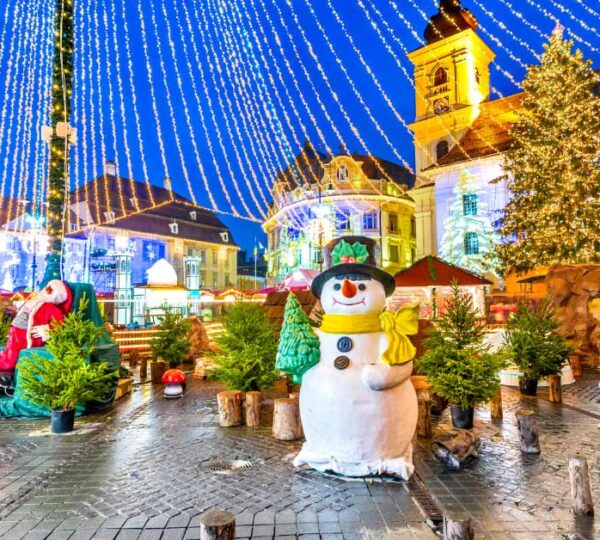
Winter (December to February) is quieter and colder, with Christmas markets and holiday lighting around the Palace of Culture if you don’t mind the temperature drop.
Whatever season you land on, our packing list essential tips are worth a look before you leave, since Iași’s continental climate swings harder between seasons than coastal or mountain destinations do.