
Romania packs an unusual amount into one country: Carpathian peaks, Black Sea coastline, medieval Saxon towns, painted monasteries, and a delta with more bird species than most entire countries. This guide is the overview: the landmarks worth building a trip around, with honest opinions on which ones earn the hype and which ones are fine to skip if you’re short on time. Where we’ve written a full, deep-dive guide to somewhere on this list, I’ll point you to it rather than repeat myself here.
Most first-time visitors try to cram all of this into a week and end up exhausted rather than charmed. My honest advice: pick two or three regions rather than all of them, and build in slower days between the driving. Romania rewards people who slow down more than other countries do.
And don’t skip the food while you’re at it. Start with sarmale (cabbage or vine leaves stuffed with minced meat and rice, slow-cooked for hours) and finish with papanași, a fried dough dumpling filled with sweet cheese and topped with sour cream and jam. Every region does its own version of both, so don’t assume the plate you get in Bucharest matches what you’ll find in a Maramureș guesthouse kitchen.
From the capital, Bucharest, to the castles and Saxon towns of Transylvania and the still-traditional villages of Maramureș, this is the shortlist I actually send people when they ask “where do I even start?”
Bucharest – the capital of Romania
Bucharest gets underrated by people who only pass through on the way to Transylvania. Give it at least a day and a half – our full Bucharest guide goes deeper on neighborhoods and food, but here’s what to prioritize.
The Old Town
Centrul Vechi is where most first-time visitors end up, and for good reason – narrow cobbled streets, old facades, packed cafes. Tucked just off Lipscani street, the small Stavropoleos Church is easy to miss and worth the two minutes it takes to find – a tiny 18th-century Orthodox church with some of the finest stone and wood carving in the city, a quiet contrast to the bars around it.
Go during the day. By night the Old Town turns into a fairly loud bar crawl circuit, which is fun if that’s what you’re after, but it’s a completely different atmosphere from the one that makes the architecture worth looking at.
The Palace of Parliament
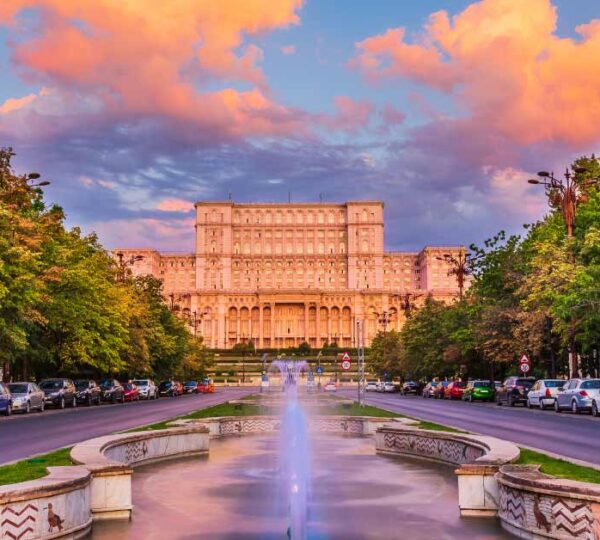
This is the world’s second-largest administrative building after the Pentagon, and also, by weight, the heaviest building on the planet – roughly 4 million tons of marble, steel and crystal, built under Ceaușescu in the 1980s. You can’t just walk in: entry is by guided tour only, you’ll need to bring a passport or ID, and it’s worth booking ahead rather than showing up and queuing. About 70 percent of the interior still sits unused – a strange, slightly haunting fact that the guides will tell you themselves.

National Museum of Art
A solid rainy-day option if you want Romanian art beyond folk crafts – the collection runs from traditional pieces to contemporary work, housed in the former Royal Palace on Revolution Square. It’s not a huge museum, so an hour or two covers it properly, and it pairs naturally with a walk around the square itself, which was the epicenter of the 1989 revolution that ended Ceaușescu’s regime.
The Village Museum
Founded in 1936 by sociologist Dimitrie Gusti, this is one of Europe’s oldest open-air museums, with around 300 authentic buildings – real houses, windmills, churches – relocated here piece by piece from villages across the country. It’s one of the better ways to understand rural Romania without actually driving to Maramureș, and it’s genuinely peaceful to walk through, not just a photo-op.

Herăstrău Park
Over 400 acres of green space with a lake you can rent a rowboat or pedal boat on. Technically it’s been called King Michael I Park since 2017, renamed after the country’s last monarch, though almost everyone – us included – still calls it Herăstrău out of habit. Honestly, it’s not a must-see, but if you need a few hours away from the city center, it’s the best version of “park” that Bucharest has to offer, and the Village Museum sits right on its edge.
Transylvania – the land of legends
Transylvania is doing a lot of the heavy lifting in Romania’s tourism reputation, and mostly it earns it – medieval towns, working farmland, and mountain roads that are genuinely worth the drive.
Bran Castle
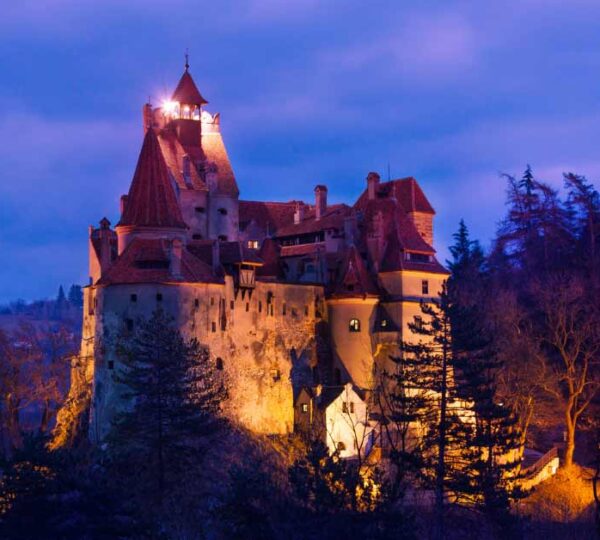
Bran Castle, often marketed as “Dracula’s Castle,” is worth an hour if you’re already in the area, mostly for the turrets and the view rather than the (fairly thin) interior. It has almost no real historical connection to Vlad the Impaler – that link is entirely a tourism-era invention – but it photographs exactly the way you’d hope, and the surrounding market stalls sell more bear-themed souvenirs than you’d expect for a castle about a vampire.

Sighișoara
Sighișoara is the actual birthplace of Vlad III, the historical figure behind the Dracula legend, and its citadel is a UNESCO World Heritage Site in its own right. We cover it in a lot more depth, along with the rest of Transylvania’s fortified Saxon villages, in our Saxon villages guide – worth reading before you go, since the old town gets genuinely crowded with tour buses in July and August.
Brașov
Brașov sits right up against the Carpathians, with the Gothic Black Church anchoring the old town and Mount Tâmpa giving you a proper panoramic view if you take the cable car or hike up. Near Piața Sfatului, the main square, look for Strada Sforii – at just over a meter wide in places, it’s one of the narrowest streets in Europe, originally built as a firefighters’ access route rather than for foot traffic. We’ve written a full guide to Brașov if you’re building more than a day trip around it.
Transfăgărășan Highway
The Transfăgărășan cuts through the Carpathians with the kind of switchbacks and alpine views that made it famous internationally. One practical note most lists leave out: it typically closes for winter, usually from around November to June, depending on snowfall, so check conditions before you build a trip around driving it. (More on Romania’s road rules, including the vignette you’ll need, in the practical tips section below.)

The castle this list is missing
If I’m honest, no “memorable landmarks” list should skip Peleș Castle in Sinaia – it’s arguably more beautiful than Bran, and actually was a royal residence, built for King Carol I in the late 19th century. Our full guide to Sinaia and Peleș Castle covers it properly.
Maramureș – preserving tradition
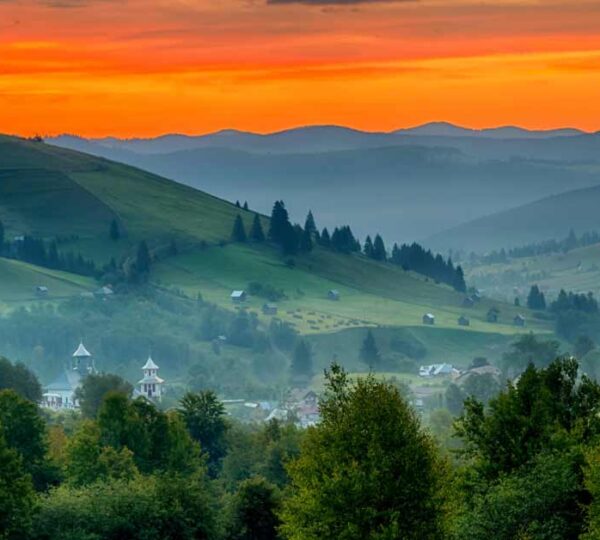
Maramureș is the region where Romania’s rural past hasn’t been tidied up for tourists – it’s still an actual working landscape, not a recreation of one. Together with the painted monasteries further south, we cover the region properly in our guide to Maramureș and Bucovina.
UNESCO sites in Maramureș
Eight wooden churches across the region were inscribed as a single UNESCO listing in 1999 – Bârsana, Budești, Desești, Ieud, Plopiș, Poienile Izei, Rogoz and Șurdești – out of roughly a hundred that still stand across Maramureș. Ieud’s church is the oldest of the eight, dating to 1364; Șurdești’s has the tallest wooden church tower in Europe, at around 70 meters. Each charges a small entrance donation, cash only.
Bârsana Monastery is the most-visited of the eight – a working monastery and its UNESCO-listed wooden church share the same grounds, and it draws more tour groups than any other site in the region, for good reason.
The Merry Cemetery, in Săpânța, is the one genuinely unusual stop on this list. Since 1935, when local artist Stan Ioan Pătraș carved the first crosses, the graveyard has filled with brightly painted headstones – “Săpânța Blue” chief among the colors – each one carrying a short, often funny epitaph about the person buried beneath it. It’s not solemn, and that’s exactly the point.

Painted Monasteries of Bucovina
Bucovina’s frescoed monasteries are a genuinely different category of sight from anything else on this list, and we go into more depth on the whole set in our guide to Romania’s most beautiful monasteries. Eight of these painted churches are inscribed together as a single UNESCO listing – Voroneț, Sucevița, Humor, Moldovița, Arbore, Pătrăuți, Probota and the Church of St. John the New in Suceava – and while Voroneț and Sucevița are the two everyone names first, Humor and Moldovița are just as striking and considerably less crowded if you have the extra half-day.
Voroneț Monastery
Founded in 1488 by Stephen the Great, Voroneț is famous for the deep blue that covers its exterior walls – “Voroneț blue” – beneath which the frescoes depict biblical scenes in exceptional detail. The nickname “the Sistine Chapel of the East” gets thrown around a lot, but for once it’s not an exaggeration.
Sucevița Monastery
Founded in 1585 by the Movilă brothers, Sucevița sits behind genuinely imposing defensive walls, with frescoes that blend Gothic and Byzantine influences in a way that’s fairly unique among Bucovina’s monasteries. I’d rank it just behind Voroneț for the art, but ahead of it for the setting – the walls and grounds feel more like a fortress than the others do.

Danube Delta – the birds’ paradise
The Danube Delta is Europe’s largest and best-preserved river delta, and it’s the one destination on this list that genuinely needs its own trip rather than a day stop – getting there means a drive to Tulcea followed by a boat, since no roads connect the villages inside it. This isn’t a quick add-on to a Transylvania itinerary; treat it as its own two or three day trip and it’ll pay you back for the effort.
It’s worth it for the sheer density of wildlife: over 300 recorded bird species, including some of Europe’s largest pelican colonies, alongside grey herons, egrets and the elusive pygmy cormorant working the shallows. Beneath the surface, the delta holds pike, perch and carp in numbers most European rivers lost decades ago; on land, otters and wild boar move through the reed beds, and the whole wetland is threaded with water lilies and floating meadows that shift with the season.
We’ve written a full guide covering permits, logistics, villages and the best time to go – the short version is April to June for birdwatching, and avoid July and August unless you’re prepared for serious mosquito numbers.

Cluj-Napoca – vibrant cultural hub
Cluj-Napoca, Romania’s second-largest city at over 300000 residents, doesn’t feel like a big city once you’re actually walking through it – the historic center keeps things at a human scale. It also happens to be home to Babeș-Bolyai University, the largest in Romania, which explains the disproportionate number of good cafes and late-night bookshops for a city this size.
The City Centre
Avram Iancu Square is the natural hub – grand buildings, cafes, and the kind of street-level energy that’s easy to just wander into for an afternoon.

The Art Museum
The Bánffy Palace, now the Cluj-Napoca Art Museum, was built between 1774 and 1786 by Count Gheorghe Bánffy and architect Johann Eberhard Blaumann, with mythological statues by Anton Schuchbauer decorating the facade. Emperor Francis I and composer Franz Liszt both visited in its heyday. Today it’s a genuinely worthwhile stop for the building alone, even before you get to the collection inside.
The Turda Salt Mines
The Turda Salt Mines are over 2000 years old, and they’re one of the more unusual things you can do in Romania – underground chambers carved from salt, a lake with boat rides, and, somewhat bizarrely, mini-golf and bowling built into a former salt cavern. It sounds gimmicky described like that, and it kind of is, but it’s still worth the detour – there’s nothing else quite like it.

Tips for your Romanian trip
What to pack: versatile clothing for variable weather, comfortable walking shoes (a lot of these sites involve uneven, cobbled, or unpaved ground), a reusable water bottle, and a universal adapter. Carry some cash in RON – not every guesthouse or rural restaurant takes cards, especially outside the bigger cities. Our full Romania packing list covers the rest in more detail.
On safety: Romania is a genuinely safe country to travel in, and violent crime against tourists is rare. Normal city-travel caution around belongings in crowded areas applies, same as anywhere.
On language and connectivity: English is widely spoken in Bucharest and the bigger tourist towns, less so in rural Maramureș or Delta villages, where a few Romanian basics go a long way – bună ziua (hello), mulțumesc (thank you), cât costă? (how much?). EU visitors’ phone plans generally work under roaming rules with no extra cost; everyone else can pick up a cheap prepaid SIM at the airport or any phone shop in Bucharest.
On driving: if you’re renting a car for Transylvania, Maramureș or the mountains, remember Romania’s roads run on the rovinieta system – a digital vignette linked to your plate rather than a paper sticker, required on national roads and motorways alike. Most rental companies include it, but ask rather than assume, since driving without one carries an on-the-spot fine.
On cost: Romania remains noticeably cheaper than Western Europe, though prices have crept up in recent years and vary a lot by region and season. As a rough guide: guesthouses and mid-range hotels run somewhere in the 150 to 400 RON per night range outside the big cities, dining out is usually 40 to 80 RON per person for a proper sit-down meal, and Bucharest’s metro costs around 5 RON per single trip (surface buses and trams run closer to 3 RON). Tipping around 10 percent is standard at restaurants, though rarely mandatory. Treat these as ballpark figures rather than fixed prices – they shift with the season and the exchange rate, so check current rates closer to your trip.